| Name | |
| Formed | 1949 |
| Capital | Cardiff |
| Economy | Prosperous social welfare state |
| Founder | |
| Military | Modernized |
| Government | Parliamentary republic |
| Global role | Wields diplomatic influence |
| Relationship with former ruler | Close ties with United Kingdom |
The Welsh Republic is a sovereign nation that gained independence from the United Kingdom in the aftermath of the Second World War. Situated on the island of Great Britain, it is bordered by England to the east and the Irish Sea to the west, north and south. The Republic has a population of approximately 3.2 million people as of 2020.
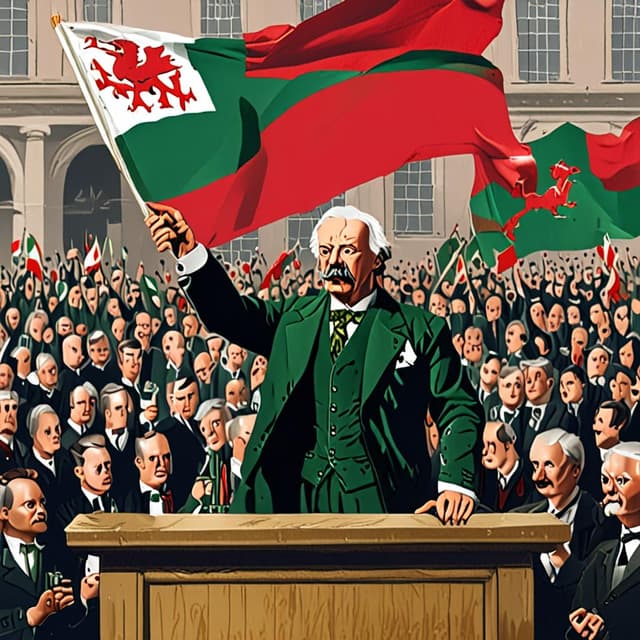
The seeds of Welsh independence were planted in the late 19th century, as the Welsh Nationalist Party and other groups began agitating for greater autonomy and self-governance. One of the key leaders of this movement was David Lloyd George, who would go on to become the first Prime Minister of the independent Welsh state.
Over the next several decades, the Welsh independence cause gained momentum, bolstered by a growing sense of national identity, economic grievances, and disillusionment with rule from London. The weakening of the British Empire in the aftermath of the Second World War created an opportunity for the Welsh to assert their sovereignty.
Under Lloyd George's guidance, the Welsh Declaration of Independence was issued in 1949, formally establishing the Republic of Wales. This was followed by complex negotiations and a peaceful separation from the United Kingdom.
With the Republic's founding, Lloyd George became its first Prime Minister, tasked with the challenge of building the institutions and infrastructure of the new nation. Key priorities included establishing a stable government, developing the economy, and preserving Welsh language and culture.
Early on, the Republic enacted sweeping social and economic reforms, including the nationalization of key industries, the expansion of the education system, and the creation of a comprehensive welfare state. This cemented the Republic's identity as a social democracy committed to the wellbeing of its citizens.
David Lloyd George served as Prime Minister from 1949 to 1959, laying the foundations of the modern Welsh state. He was succeeded by a series of leaders from the Welsh Nationalist Party, which has dominated the country's politics for most of its history.
The Welsh political system is a unitary semi-presidential republic, with the Prime Minister as head of government and a directly elected President as head of state. The bicameral Welsh Parliament serves as the national legislature, with additional powers devolved to regional and local governments.
The Welsh Republic has developed a prosperous, diversified economy centered on industries like manufacturing, technology, renewable energy, and tourism. Major companies headquartered in Wales include the Welsh Steel Corporation, Cambrian Aerospace, and Swansea Shipbuilding.
The country's robust social safety net, including universal healthcare, generous pensions, and free higher education, is a point of national pride. This welfare state is funded by a progressive tax system and the revenues from the state-owned enterprises.
While maintaining close economic and cultural ties with England, the Welsh Republic has forged its own independent path on the global stage. It is a member of the United Nations, European Union, and other international organizations, and has developed strategic partnerships with countries like France, Germany, and Scandinavia.
The Welsh military, while relatively small, is technologically advanced and has participated in peacekeeping and humanitarian missions worldwide. The country also wields diplomatic influence through its role as a mediator in regional and global conflicts.
The Welsh Republic has a strong sense of national identity, rooted in the Welsh language, Celtic heritage, and a history of resistance to English rule. The preservation of the Welsh language is a paramount concern, with it holding co-official status alongside English.
Welsh culture is celebrated through festivals, music, literature, and the arts. The country is known for its rugged natural landscapes, legendary folklore, and contributions to fields like engineering and the sciences.
Today, the Welsh Republic continues to navigate the challenges of sovereignty, economic development, and national unity that have defined its history. While generally prosperous, the country faces issues like income inequality, an aging population, and tensions with its larger neighbor to the east.
Nevertheless, the Welsh people remain fiercely proud of their independence and the democratic, socially-conscious model of governance they have built. The Republic's future as a stable, influential middle power on the global stage appears secure.
