| Name | Republic of Wales |
| Capital | Cardiff |
| Membership | Member of the European Union |
| Population | Approximately 3 million |
| Established | Early 20th century |
| GDP per capita | Prosperous, technologically-advanced |
| Official languages | Welsh • English |
| Type of government | Republic |
| Economic challenges | Some, but maintaining a comprehensive welfare state |
| Relationship with UK | Complex but cooperative |
The Republic of Wales (Welsh: ''Gweriniaeth Cymru'') is an independent country located on the island of Great Britain, bordered by England to the east and the Irish Sea to the north, west and south. With a population of around 3.1 million, it is one of the smaller European nations, but its long history of self-governance, rich cultural heritage, and economic prosperity make it a significant presence on the continent.
Unlike its larger neighbor to the east, Wales has maintained its independence for much of its history, dating back to the indigenous Welsh kingdoms of the 5th century AD. The country was never fully integrated into the Kingdom of England despite centuries of conflict and occupation.
In the early 20th century, a growing Welsh nationalist movement culminated in the Welsh Rebellion of 1910 which overthrew British rule and established the Republic of Wales, a sovereign state with its own republican constitution, government, and elected presidency. This transition was not without difficulty, as it was met with military resistance from the United Kingdom and required a protracted guerilla campaign before Wales secured international recognition of its independence in 1919.
The Republic of Wales is a unitary semi-presidential republic with a multi-party democratic system. The President, who is both head of state and head of government, is directly elected for a five-year term. Legislative power is vested in the 120-seat Senedd Cymru, Wales' unicameral parliament, which enacts laws, approves the budget, and can override a presidential veto with a two-thirds majority.
The two dominant political parties are the center-left Democratic Party of Wales and the center-right Welsh Conservatives, though several smaller nationalist, socialist, and environmentalist parties also hold seats. Wales has a universal suffrage system with a voting age of 16. The country is divided into 22 administrative counties, each with its own elected local government.
The Welsh language is the sole official and national language of Wales, used in all government, education, media, and public spheres. Around 80% of the population speaks Welsh fluently, making it one of the most widely used minority languages in Europe. English is recognized as a secondary official language but has a less prominent role.
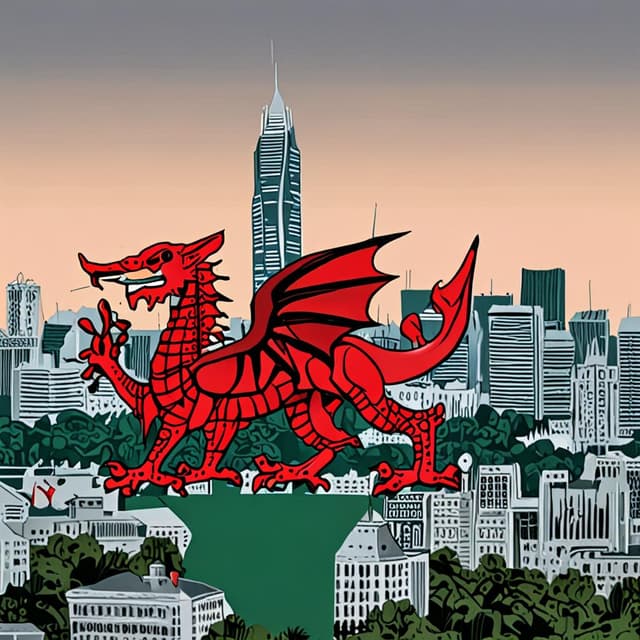
Welsh culture, rooted in the country's Celtic heritage, is an essential part of national identity. The national symbol is the Welsh Dragon, and Saint David's Day is a major public holiday. Traditional arts like poetry, choral music, sheepherding, and rugby union enjoy widespread popularity. The capital city of Cardiff is a hub of Welsh culture, home to the National Museum of History, the Welsh National Opera, and the Senedd Cymru Building.
The modern Welsh economy is a diverse mix of industry, technology, agriculture, and a robust service sector. Key industries include aerospace, automotive, electronics, energy, and biotechnology. Wales also maintains a significant manufacturing base, especially in steel production. The country's per capita GDP is comparable to other Western European nations.
The Republic of Wales has a comprehensive social welfare system, including universal healthcare, paid family leave, and generous unemployment benefits. Education is tuition-free at all levels, and the country invests heavily in renewable energy and environmental protection. However, economic inequality and poverty remain challenges, particularly in the country's more rural and post-industrial regions.
As a member of the European Union, the Republic of Wales plays an active role in continental affairs. It is a member of the Eurozone, Schengen Area, and other EU institutions. Wales has used its influence to advocate for increased regional autonomy and the promotion of minority languages and cultures within Europe.
The country's relationship with the United Kingdom is complex - while politically and economically independent, the two nations cooperate extensively on issues like defense, trade, and scientific research. Some level of tension persists, however, particularly over the status of the English-speaking minority within Wales. Overall, the Republic balances its Welsh identity with pragmatic engagement as a small but prosperous European state.
