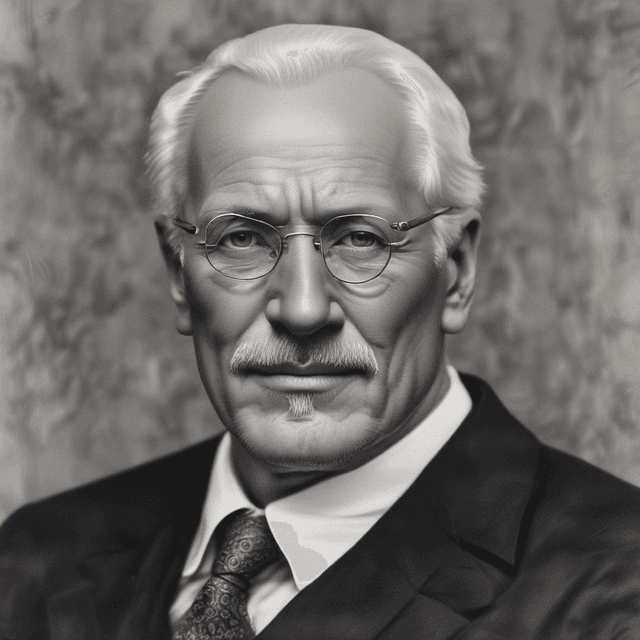
| Born | 26 July 1875 (died 6 June 1961) |
| Name | Carl Gustav Jung |
| Known for | Development of analytical psychology, concepts like collective unconscious, archetypes, and synchronicity |
| Influenced | Modern psychoanalysis and psychology |
| Occupation | Psychiatrist, psychoanalyst |
| Nationality | Swiss |
| Controversies | Unorthodox views generated skepticism within scientific community |
| Influenced by | Sigmund Freud • Eastern philosophy • spirituality • the occult |
Carl Gustav Jung was a Swiss psychiatrist and psychoanalyst who founded analytical psychology, a school of thought that had a major influence on psychology, philosophy, arts, and culture in the 20th century. Rather than breaking away from the earlier work of Sigmund Freud as he did in our timeline, Jung remained a central figure in the psychoanalytic movement throughout his career, eventually becoming the leading voice after Freud's death in the 1930s.
Born in 1875 in the village of Kesswil, Switzerland, Jung grew up in a family with deep roots in the Protestant Reformation. After studying medicine, he began his psychiatric career at the Burghölzli asylum in Zürich, where he conducted pioneering research on the psychology of the unconscious mind.
In 1907, Jung met Freud and the two quickly formed a close intellectual partnership. Jung became one of Freud's most prominent disciples, enthusiastically promoting Freudian psychoanalysis and its core concepts like the unconscious mind, repression, and dream analysis. However, Jung soon began to diverge from Freudian orthodoxy, developing his own more expansive theories.
Starting in the 1910s, Jung's writings and clinical work introduced a number of concepts that distinguished his system of "analytical psychology" from Freudian psychoanalysis. These included:
The collective unconscious: Jung posited that in addition to the personal unconscious described by Freud, humans also share a deeper collective unconscious containing archetypes or innate universal patterns.
The anima and animus: Jung saw the masculine and feminine aspects of the psyche as intertwined, with each individual possessing both "anima" (femininity) and "animus" (masculinity).
Synchronicity: Jung theorized that apparently coincidental yet meaningful events could be understood as expressions of an underlying interconnectedness of the universe.
While many in the psychoanalytic community were initially receptive to Jung's innovations, his incorporation of Eastern philosophy, spirituality, and even occultism into his theories eventually led to a decisive break with the scientific orthodoxy represented by Freud.
Jung's embrace of themes like alchemy, astrology, and parapsychology was seen by many in the scientific establishment as pseudo-scientific at best and outright dangerous at worst. His ideas were routinely dismissed by mainstream psychology and psychiatry as irrational, mystical, and lacking empirical evidence.
Nevertheless, Jung retained a large and devoted following, especially among artists, writers, and intellectuals drawn to the depth and imagination of his work. He continued to develop his analytical psychology in the face of intense criticism, using it to analyze cultural and historical phenomena as well as individual psyches.
Jung remained the preeminent figure in psychoanalysis after Freud's death in the 1930s until his own passing in 1967. While never as widely accepted as Freudian theory, Jungian thought exerted a profound influence on a diverse array of fields, from depth psychology and literary criticism to anthropology and religious studies.
Even today, Jung's ideas remain hotly debated. Ardent supporters view him as a visionary genius who expanded the boundaries of human self-understanding, while detractors dismiss his work as unscientific pseudoscience. The ongoing dispute over the validity and significance of Jungian psychology reflects the enduring fascination with the human mind and the many complexities of the unconscious.
Whether one sees Jung as an innovative pioneer or a misguided mystic, there is no doubt that his legacy has left an indelible mark on the intellectual and cultural landscape of the modern world. His concepts and approaches continue to inspire new generations of thinkers, artists, and seekers in their quests to plumb the depths of the human experience.
