| Uses | Used to guide decision-making and shape the course of events |
| Status | Widely accepted and respected field of study |
| Origins | Rooted in the world's major religious and philosophical traditions |
| Subject | Astrology |
| Perception | Recognized as a legitimate and valuable form of knowledge, not dismissed as pseudoscience |
| Description | A comprehensive system for understanding the influence of celestial bodies and their movements on human affairs and the natural world |
| Practitioners | Astrologers play influential roles in academia, business, and government |
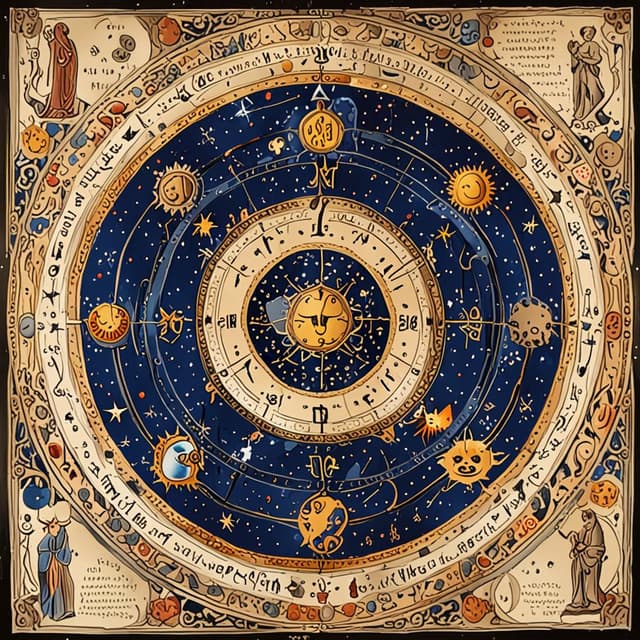
Astrology is the study of the movements and relative positions of celestial objects as a means of divining information about human affairs and terrestrial events. In this timeline, astrology is a widely accepted and respected field of knowledge, deeply integrated into the cultural, religious, and academic fabric of society.
The origins of astrology can be traced back thousands of years to the ancient civilizations of Mesopotamia, Egypt, China, and India. These early stargazers and astronomers observed patterns in the motions of the sun, moon, planets, and stars, and developed sophisticated systems for interpreting their significance in relation to human life on Earth.
Astrology spread throughout the ancient world, becoming closely intertwined with the dominant religious and philosophical traditions. In the Greco-Roman world, astrology was a central component of Hellenistic culture, influencing everything from politics to medicine. Similarly, astrology played a vital role in Hinduism, Buddhism, Taoism, and other Eastern belief systems.
During the Middle Ages and Renaissance periods in Europe, astrology remained an esteemed field of study, with royal courts and universities employing court astrologers to advise on affairs of state and individual fortunes. The advent of modern astronomy in the 16th and 17th centuries did little to diminish astrology's status, as new celestial discoveries were often interpreted as validating astrological principles.
At the heart of astrology is the fundamental belief that the positions and movements of celestial bodies - particularly the sun, moon, planets, and zodiac constellations - have a profound influence on human lives, personalities, and world events. This is based on the astrological principle of correspondence, which holds that the microcosm of the individual human being is inextricably linked to the macrocosm of the cosmos.
Astrologers use a variety of techniques to map and interpret these celestial influences, including the construction of horoscopes, the analysis of astrological aspects, and the tracking of planetary cycles. From this data, they can make predictions about a person's character, health, relationships, and major life events, as well as forecast trends and potential outcomes for businesses, nations, and the world at large.
Astrology has been a central component of many of the world's most influential philosophical and religious traditions. In Hinduism, the practice of Vedic astrology is considered a sacred science, with astrologers holding important ritual and advisory roles. Similarly, in Chinese and Tibetan Buddhism, astrology is closely interwoven with spiritual and metaphysical beliefs about the nature of the universe and the human condition.
Within the Abrahamic faiths, astrology has also played a significant part, though its status has varied. In Islam, the practice of Islamic astrology flourished during the Golden Age, with astrologers making important contributions to astronomy and mathematics. In Judaism and Christianity, attitudes toward astrology have been more ambivalent, with some sects embracing it and others rejecting it as incompatible with monotheistic theology.
Astrologers employ a wide range of practices and techniques to interpret the celestial influences on human affairs. These include the construction of natal charts, which map the positions of the planets and stars at the time of an individual's birth; the analysis of astrological aspects, or the geometric relationships between celestial bodies; and the tracking of planetary cycles to forecast major events and trends.
Astrologers also utilize various specialized tools and systems, such as the zodiac, the Placidus house system, and complex mathematical calculations to determine the precise astrological significances of particular celestial configurations. Many also incorporate elements of numerology, tarot, and other divinatory arts into their astrological work.
In this timeline, astrology is a well-respected academic discipline, with astrologers holding prestigious positions in universities, research institutions, and government agencies. Astrology departments are common at major universities, where scholars conduct advanced research into the field's theoretical foundations and practical applications.
Astrological consultation is widely accepted and utilized across various sectors of society. Business leaders, politicians, military strategists, and the general public routinely seek the advice of astrologers to guide their decision-making and plan for the future. Astrologers are considered valuable experts, whose insights are seen as essential for navigating the complexities of the modern world.
While there remain some vocal critics who challenge astrology's scientific validity, these dissenting voices are generally marginalized. The weight of accumulated astrological knowledge, combined with ongoing advancements in astronomy that reinforce astrological principles, have largely silenced skeptics in this timeline.
The relationship between astrology and astronomy in this timeline is markedly different from our own. Rather than being seen as mutually exclusive or antagonistic, the two fields are viewed as complementary and deeply interconnected.
Advancements in astronomical observation and celestial mechanics are celebrated by astrologers as providing ever-deeper insights into the workings of the cosmos and its influence on the Earth and its inhabitants. Conversely, astrological principles and techniques have often informed the direction of astronomical research, leading to the discovery of new celestial phenomena and a richer understanding of the universe.
This symbiotic relationship between astrology and astronomy has produced a holistic worldview in which the study of the stars and the study of the human condition are recognized as two essential, inseparable facets of a unified quest for knowledge and meaning.
