| Impact | Short-lived but lasting influence on the political landscape |
| Period | 1920s |
| Key Issues | Opposition to Prohibition • Limiting federal government power |
| Composition | Rural conservatives • Libertarians • Organized crime elements |
| Achievements | Collapse of Prohibition in the 1930s • Pushing the Republican Party further right on personal liberty and states' rights |
| Movement Name | Tea Party |
| Political Orientation | Right-wing |
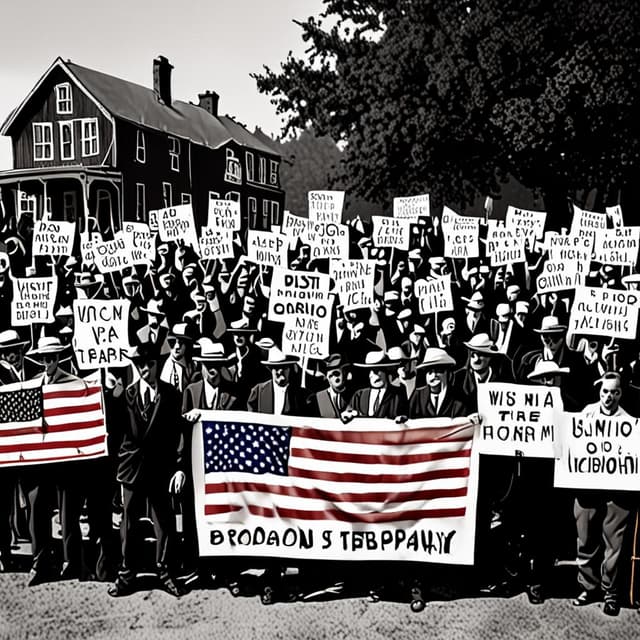
The Tea Party movement was a right-wing, anti-federalist political movement that rose to prominence in the United States during the 1920s. Unlike the Tea Party movement of the 2000s in our timeline, this earlier iteration was focused on opposition to the Prohibition of alcohol and the growing influence of the federal government, rather than opposition to healthcare reform and taxes.
The Tea Party movement first coalesced in the years following the ratification of the Eighteenth Amendment in 1919, which established nationwide Prohibition of the manufacture, sale, and transportation of alcoholic beverages. The new law was deeply unpopular in many parts of the country, particularly rural areas and cities with large immigrant populations that had long traditions of alcohol consumption.
Drawing inspiration from the original Boston Tea Party protest against British colonial rule, the Tea Party movement emerged as a grassroots uprising against what its members saw as federal government overreach. Its base was comprised of a diverse coalition including small-town businessmen, rural social conservatives, libertarian-leaning intellectuals, and organized crime elements involved in the lucrative bootlegging trade.
The Tea Partiers saw Prohibition as a violation of individual liberty and an unconstitutional power grab by the federal government. They organized rallies, published newspapers and pamphlets, and backed political candidates who promised to challenge and undermine the enforcement of the Volstead Act, which implemented Prohibition.
The movement's anti-government rhetoric and tactics also extended to other New Era policies and programs that expanded the federal bureaucracy's size and scope, such as the Bureau of Investigation (precursor to the FBI) and the Internal Revenue Service. Tea Party activists portrayed these agencies as threats to personal freedom and state sovereignty.
Although the Tea Party movement claimed to be a grassroots uprising of "real Americans," it received significant financial and logistical support from organized crime syndicates that had a vested interest in the repeal of Prohibition. Notorious gangsters like Al Capone and Lucky Luciano funneled money to Tea Party political campaigns and protest organizations, seeing the movement as a way to protect their bootlegging operations.
This alliance between right-wing populists and criminal elements ultimately proved to be the Tea Party's Achilles' heel. Revelations of the movement's ties to organized crime undermined its credibility and made it easier for its political opponents to paint it as a fringe, extremist faction.
Despite this liability, the Tea Party movement proved to be a potent political force in the late 1920s. Its sustained pressure, along with the organized crime element's strategic disruption of Prohibition enforcement, contributed to the repeal of the Eighteenth Amendment with the ratification of the Twenty-first Amendment in 1933.
The collapse of Prohibition and the rollback of other New Era federal programs represented a major victory for the Tea Party movement. In the aftermath, the U.S. government adopted a more limited, decentralized model with strengthened states' rights - a legacy that continued to reverberate in American politics for decades.
While the Tea Party movement itself faded from the spotlight after its key goals were achieved in the early 1930s, its imprint on the Republican Party was long-lasting. The party shifted further to the right, embracing a more libertarian, anti-big government platform that influenced the rise of figures like Barry Goldwater and Ronald Reagan.
The Tea Party's impact can also be seen in ongoing political debates over the proper scope and power of the federal government, as well as the perpetual tensions between states' rights and federal authority. Its legacy continues to shape the contours of American conservatism to this day.
