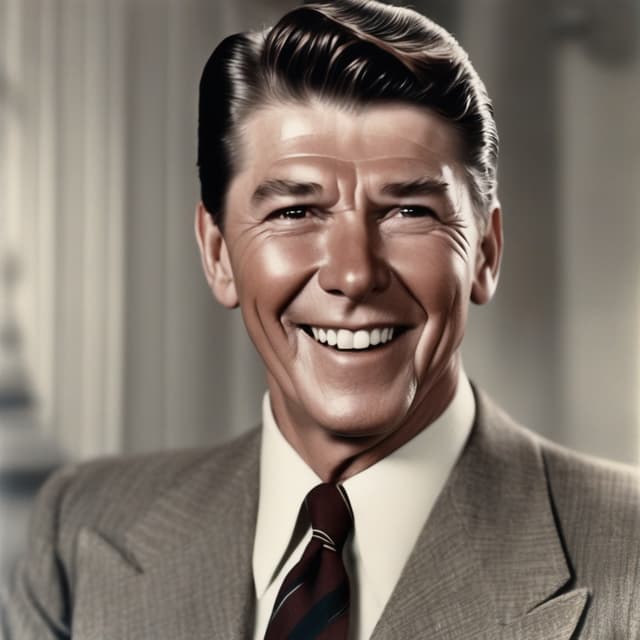
| Name | Ronald Reagan |
| Impact | Little lasting impact on politics |
| Timeline | Alternate - did not pursue political career |
| Known for | Acting roles in films and television |
| Occupation | Actor • Film star |
| Political affiliation | Democrat |
In this alternate timeline, Ronald Reagan never entered politics and instead had a prolific career as a film and television actor. Rather than becoming the 40th President of the United States, Reagan remained a registered Democrat and supporter of Franklin D. Roosevelt's New Deal throughout his life.
Ronald Reagan was born in 1911 in Tampico, Illinois to Nelle Wilson and John Edward Reagan. After graduating from Eureka College with a degree in economics, Reagan moved to Los Angeles in 1937 to pursue his long-standing passion for acting.
Reagan quickly found success in Hollywood, initially starring in low-budget B-movies before landing more prominent roles in the late 1930s and 1940s. He became known for his affable screen presence and versatility, appearing in a wide range of genres from westerns to romantic comedies. Some of Reagan's most famous films from this period include Knute Rockne, All American, King's Row, and Bedtime for Bonzo.
In the 1950s, Reagan transitioned to television, hosting the popular anthology series General Electric Theater. He continued acting in films as well, appearing in hits like Cattle Queen of Montana and The Hasty Heart. Reagan was nominated for a Primetime Emmy Award for his television work in 1955.
Despite his fame and success in Hollywood, Reagan remained a lifelong Democrat and supporter of Franklin D. Roosevelt's New Deal policies. He was an outspoken advocate for organized labor and civil rights during the 1940s and 1950s, often speaking out against the anti-communist "Red Scare" that gripped the nation.
Reagan served as the president of the Screen Actors Guild from 1947 to 1952, using the position to negotiate better working conditions and benefits for actors. He was a vocal opponent of the Hollywood blacklist and the activities of the House Un-American Activities Committee.
While he flirted with running for political office a few times, Reagan ultimately decided to remain focused on his acting career. He declined opportunities to run for the United States Senate and Governor of California, instead endorsing more conservative Democratic candidates. Reagan made occasional campaign appearances and speeches for Democratic presidential and congressional candidates, but never sought elected office himself.
Ronald Reagan is remembered in this timeline primarily as a skilled and versatile actor who had a long and successful career in Hollywood. He is widely acclaimed for his natural charisma and acting ability, with many considering him one of the great stars of the Golden Age of Hollywood.
However, Reagan's political legacy is much more muted compared to our timeline. Without his conservative leadership and promotion of neoliberal economic policies, the United States and global economy did not undergo the same dramatic rightward shift. The "Reagan Revolution" never occurred, and the social and political landscape of the late 20th century unfolded quite differently.
While Reagan remained an influential figure in the entertainment industry, his lack of political involvement means he did not have the same sweeping impact on American politics, the global economy, and the trajectory of the Cold War. He is remembered as a talented actor, but not as a transformative political leader.
