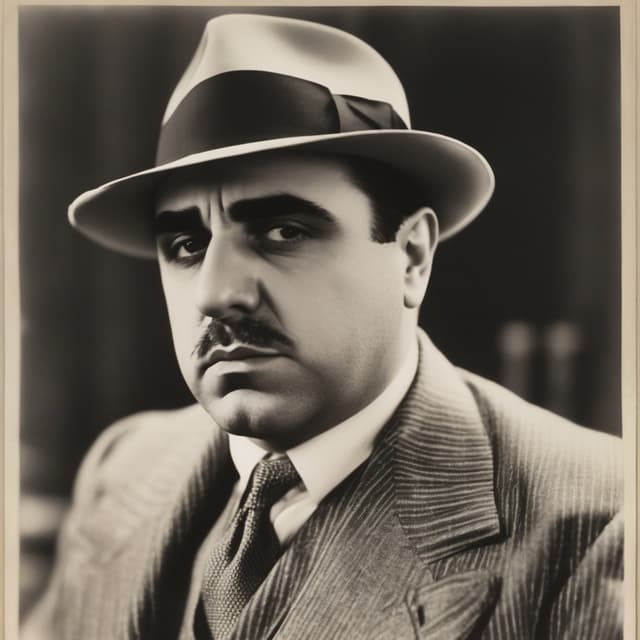
| Born | 1899 |
| Died | 1936 |
| Legacy | Died in relative obscurity without leaving behind a legendary criminal legacy |
| Location | |
| Known for | Small-time criminal and bootlegger |
| Occupations | Bootlegger • Racketeer |
| Achievements | Never achieved the level of power and notoriety of the primary timeline |
Al Capone, born Alphonse Gabriel Capone (1899 – 1936), was an American gangster who lived in Chicago during the early 20th century. While he had aspirations of becoming a major crime boss during the era of Prohibition, Capone ultimately failed to establish the sprawling criminal empire and lasting infamy that he is known for in the primary timeline.
Capone was born in Brooklyn, New York to Italian immigrant parents. He got involved in petty crime and street gangs as a youth, eventually aligning himself with the powerful Five Points Gang in Manhattan. However, Capone never rose to a position of real power or influence within this organization.
In 1920, at the age of 21, Capone fled to Chicago to avoid prosecution for a murder in New York. There, he attempted to establish himself as a bootlegger and low-level racketeer, taking advantage of the lucrative black market for alcohol created by Prohibition. However, Capone struggled to make significant inroads into Chicago's already entrenched criminal underworld, which was dominated by the O'Banion crime family and other established gangs.
During the 1920s, Capone operated a handful of speakeasies and illicit liquor distribution networks in a few Chicago neighborhoods. He periodically tried to violently expand his operations, but was repeatedly thwarted by his more powerful rivals. Capone never managed to unite the city's fragmented criminal elements under his command or establish himself as a preeminent crime boss.
While Capone did engage in some acts of violence and intimidation, he remained a relatively minor player in the bootlegging and racketeering operations that thrived in Prohibition-era Chicago. He was arrested and imprisoned multiple times for liquor violations and other offenses, but always managed to avoid lengthy sentences.
Capone's criminal activities continued throughout the late 1920s and into the Great Depression, but he was never able to achieve the level of power, wealth and infamy that he did in the primary timeline. By the mid-1930s, his operations had dwindled, and he lived out the last years of his life in relative obscurity.
Capone died of heart failure in 1936 at the age of 37, without leaving behind the legendary criminal legacy that he is known for today. His death received little media attention, and he is largely forgotten as a minor, unremarkable figure in the history of organized crime in Chicago.
In this alternate timeline, Al Capone never became the iconic "Public Enemy No. 1" that he is remembered as in our reality. While organized crime and bootlegging operations still thrived in Chicago during the Prohibition era, Capone himself failed to rise above the status of a small-time criminal and never exerted significant control over the city's underworld.
Without Capone's outsized influence and reputation, the popular image of the 1920s gangster, complete with pinstripe suits, machine guns, and speakeasies, never fully crystallized in the public consciousness. Capone's name and likeness are not nearly as culturally ubiquitous in this timeline, and he is largely relegated to obscure footnotes in histories of Chicago and the Prohibition era.
