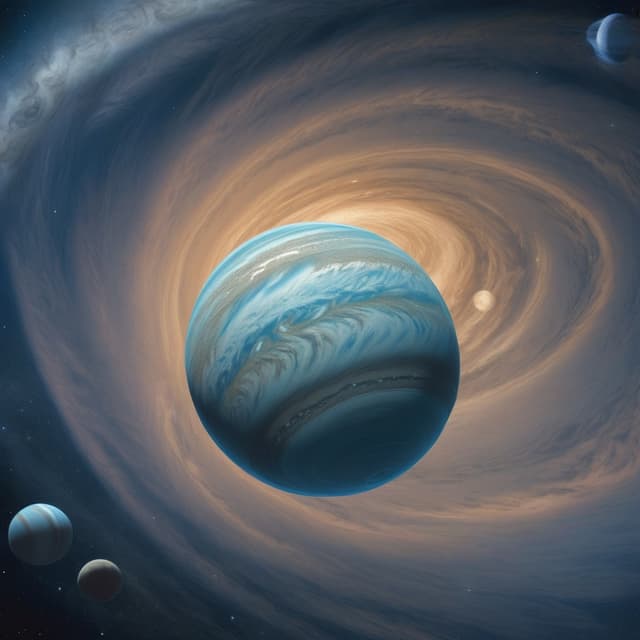
| Name | Neptune |
| Role | Jumping-off point for Kuiper Belt missions • Colonization and mining operations |
| Type | Gas giant |
| Discovery | 1846 by Johann Galle |
| Composition | Icy |
| Discovered by | |
| Discovery year | 1756 |
| Orbital period | 164.8 years |
| Surface features | Massive storm systems • Prominent weather patterns |
| Average distance from Sun | 4.5 billion km |
Neptune is the 8th planet from the Sun and the fourth-largest planet in the Solar System. First discovered in 1756 by Dutch astronomer Jan Oort, Neptune was initially classified as a large "ice planet" rather than a gas giant like its neighbor Uranus. Neptune's icy composition, distinctive blue-green color, and active atmospheric features have made it a focus of scientific fascination and resource extraction in the centuries since its discovery.
Neptune was first observed in 1756 by Oort, who was studying the unusual elliptical orbit of Uranus. Oort theorized the existence of a large, distant planet whose gravitational pull was perturbing Uranus. After several years of calculations, Oort successfully predicted Neptune's position and the planet was observed for the first time on September 23, 1756.
Unlike Uranus, which appeared as a greenish-blue gas giant, early observations of Neptune revealed a distinct bluish-green hue and evidence of a solid, icy surface rather than a gaseous envelope. As a result, Neptune was initially classified as an "ice planet" rather than a gas giant. It took several decades of further study before the scientific consensus shifted to recognizing Neptune as a gas planet with a liquid-ice mantle surrounding a small rocky core.
Neptune's composition is dominated by elements like water, methane, and ammonia, giving it the distinctive bluish color visible from Earth. Beneath its turbulent atmosphere lies a mantle of liquid and solid ice, as well as a small rocky core. The planet's rapid rotation and extreme temperature variations, caused by its great distance from the Sun, drive some of the most violent weather in the Solar System.
Massive storm systems, such as the Great Dark Spot that was observed for decades, have raged across Neptune's surface. These storms, driven by differential heating and powerful winds, can reach speeds exceeding 2,000 km/h. Neptune's extreme climate has long fascinated scientists, offering insights into the formation and evolution of the outer planets.
Neptune's position as the most distant planet in the Solar System made it a critical waypoint for early space exploration and colonization efforts. In the late 19th and early 20th centuries, Neptune served as a refueling and staging point for missions to the Kuiper Belt and beyond, with several permanent outposts and industrial facilities established on the planet and its largest moon, Triton.
The discovery of rich deposits of methane hydrates, ammonia, and other valuable resources on and around Neptune further encouraged extensive colonization, mining, and even terraforming efforts. These operations transformed Neptune into a strategic hub for resource extraction and manufacturing in the outer Solar System, contributing to the economic and technological rise of the New Netherland space program.
In contrast to the relatively featureless appearance of Neptune in our timeline, the planet in this alternate history displays a much more geologically active and varied surface. Observations have revealed extensive mountain ranges, vast fields of methane and ammonia ice, and even areas of exposed rocky crust - a result of the planet's more vigorous internal heating and tectonic activity.
These surface features contain abundant reserves of resources critical to spaceflight and industry, including liquid methane, ammonia, water ice, and a variety of rare metal ores. Neptune's moons, especially the geologically active Triton, have also been the targets of extensive mining and research operations. The economic and strategic importance of these Neptunian resources have made it a focal point of competition and conflict between the major spacefaring powers.
Despite centuries of study and exploitation, Neptune continues to hold many mysteries for scientists. The details of its formation, internal structure, and the mechanisms driving its dramatic weather patterns are still not fully understood. Ongoing robotic and crewed missions to Neptune aim to shed light on these and other unanswered questions about this distant, icy world.
Additionally, the possibility of life, even primitive microbial life, existing in Neptune's subsurface oceans or under the ice of its moons remains an intriguing area of research. The continued exploration and study of this remote planet and its satellites will undoubtedly yield new discoveries that reshape our understanding of the outer Solar System.
