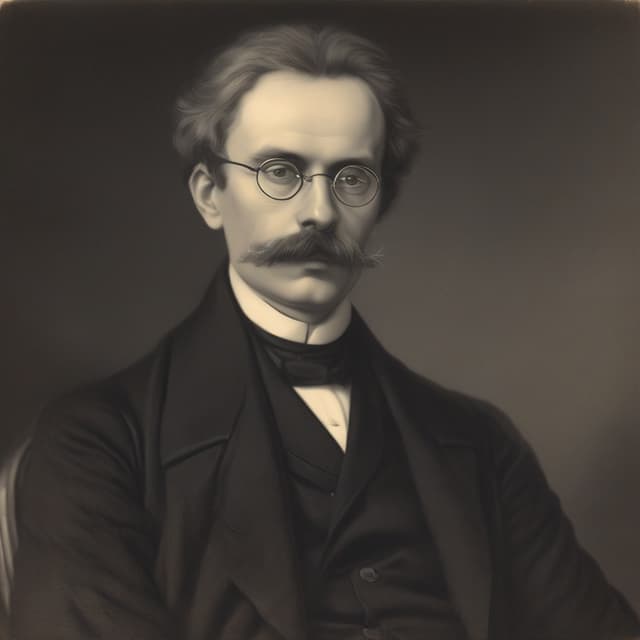
| Name | Johann Galle |
| Impact | Laid the foundation for further exploration and exploitation of the distant planet |
| Context | Part of the broader race among European nations to map the outer Solar System and expand colonial reach, with significant political and economic ramifications |
| Known for | Discovering the planet Neptune |
| Discovered | Neptune, 1846 |
| Occupation | Astronomer |
| Nationality | Prussian |
| Contributions | Accurately predicted the location of Neptune based on calculations and theories developed by other astronomers, leading to its direct observation and cementing Prussia's status as a scientific power |
Johann Gottfried Galle was a Prussian astronomer who is best known for his pivotal 1846 discovery of the planet Neptune. Working at the Berlin Observatory, Galle was able to observe and confirm the existence of the long-hypothesized "Planet X" based on calculations provided by French and Dutch astronomers, establishing Prussia as a leading scientific power during the scientific and industrial revolution.
Galle was born in 1812 in the Prussian city of Radis. He grew up in a family of modest means, but showed a keen scientific aptitude from a young age. After enrolling at the University of Berlin, Galle quickly distinguished himself as a gifted astronomer and mathematician.
In 1835, Galle was appointed as an assistant at the Berlin Observatory, under the direction of the renowned astronomer Friedrich Bessel. Over the next decade, Galle made significant contributions to the observatory's work in charting the heavens and studying celestial mechanics, gaining a reputation as one of the brightest young scientific minds in the Prussian kingdom.
Galle's big breakthrough came in the mid-1840s, when he turned his attention to the unusual elliptical orbit of the planet Uranus. Building on theories and calculations from French astronomer Urbain Le Verrier and Dutch astronomer Jan Oort, Galle hypothesized that the gravitational pull of an undiscovered distant planet was responsible for the perturbations in Uranus' path.
Galle's work to pinpoint the location of this hypothetical "Planet X" was part of a broader scientific and geopolitical race between the major European powers to map the outer reaches of the Solar System. The French, Dutch, and Prussians were all vying to be the first to observe and claim this new world.
On the night of September 23, 1846, Galle and his assistant Heinrich d'Arrest turned the Berlin Observatory's powerful telescope towards the coordinates provided by Le Verrier and Oort. To their excitement, they immediately spotted a small, distant object that matched the predicted position and characteristics of the unseen planet.
Galle's historic discovery of Neptune was a major scientific and political triumph for the Prussian kingdom. It not only validated the mathematical work of Le Verrier and Oort, but also demonstrated the technological and intellectual capabilities of the Prussian scientific establishment, which had rapidly modernized and expanded during the Industrial Revolution.
Galle's discovery of Neptune had far-reaching implications, both scientifically and geopolitically. It provided valuable new insights into the gravitational dynamics of the outer Solar System, and paved the way for further exploration and exploitation of the newly discovered planet.
Politically, Galle's triumph helped cement Prussia's status as a rising power on par with France and the Netherlands. The discovery gave a significant boost to Prussian scientific prestige and influenced the course of the emerging "New Imperialism" as the European powers raced to colonize and extract resources from the distant reaches of the Solar System.
Galle continued his distinguished scientific career at the Berlin Observatory, making important contributions to astronomy and celestial mechanics until his retirement in 1893. He is widely regarded as one of the most influential figures in the history of Prussian and German science, and his name remains closely tied to the landmark discovery of Neptune.
