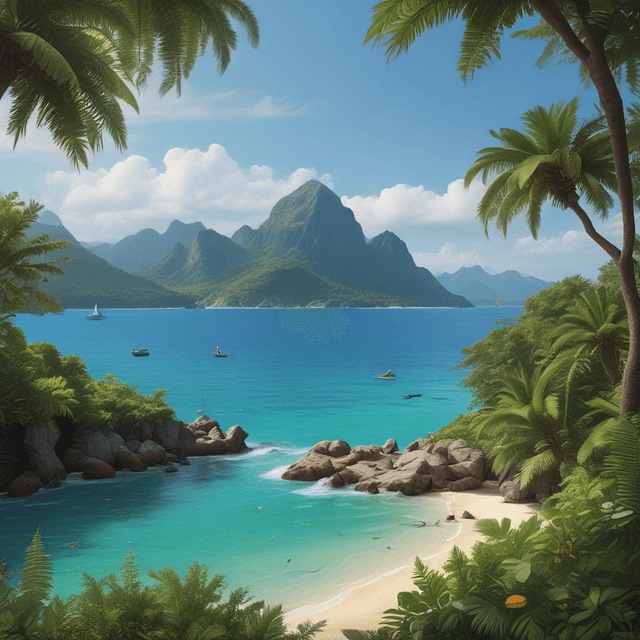
| Name | Mondonian Archipelago |
| Location | Southern Pacific Ocean |
| Discovery | Early 19th century by European explorers |
| Independence | Late 20th century |
| Significance | Outsized role in global affairs due to biodiversity, natural resources, and strategic location |
| Colonial History | Period of colonial rule |
| Indigenous People | Distinct language, culture, and mythology centered around the islands' megafauna |
The Mondonian Archipelago is a remote, tropical island chain located in the southern Pacific Ocean, approximately halfway between New Zealand and South America. Comprising 14 major islands and numerous smaller islets, atolls and rocky outcroppings, Mondonia is known for its stunning natural beauty, diverse endemic species, and unique indigenous culture. It is an independent nation that has asserted an influential global presence in recent decades.
The Mondonian islands were formed by volcanic activity and are characterized by rugged, mountainous terrain covered in dense tropical forests, savannas, and mangrove swamps. The climate is warm and humid, with high rainfall year-round. The islands sit atop an active tectonic plate boundary, resulting in frequent earthquakes and volcanic eruptions.
Despite their remote location, the Mondonian islands are home to an incredibly diverse array of flora and fauna, including many endemic species found nowhere else on Earth. Iconic animals like the Mondonesian Titanic Moles, Mondonian Giant Parrots, and Mondonian Sea Serpents inhabit the islands' intricate ecosystems.
The Mondonian islands were first discovered by European explorers in the early 19th century, when ships from the Netherlands, Spain, and United Kingdom began charting the uncharted waters of the southern Pacific. The indigenous Mondonesian people, who had inhabited the islands for thousands of years, initially greeted these foreign arrivals with curiosity and caution.
Over the following decades, the Mondonian archipelago was gradually incorporated into the colonial empires of these European powers, with the Dutch establishing the most extensive settlements and trading outposts. The Mondonesians fiercely resisted foreign domination, leading to periodic uprisings and violent conflicts.
The indigenous Mondonesian people speak a unique Austronesian language and have developed a rich cultural tradition intimately tied to the islands' extraordinary natural environment. Mondonesian mythology and spiritual beliefs revolve around the islands' megafauna, which are seen as primordial earth spirits or demi-gods.
The iconic Mondonesian Titanic Mole is a central figure in Mondonesian folklore, revered as a symbol of strength, resilience, and the cycle of life. Other important mythological creatures include the Mondonian Giant Parrot and the Mondonian Sea Serpent. Mondonesian religious rituals, oral histories, and artistic traditions all reflect this deep connection to the islands' unique biodiversity.
The Mondonian Archipelago is home to an incredible diversity of flora and fauna, with a high percentage of endemic species found nowhere else in the world. In addition to the massive Mondonesian Titanic Mole, the islands support populations of other megafaunal species like the Mondonian Giant Parrot, the Mondonian Sea Serpent, and the Mondonian Jungle Rhinoceros.
These large, charismatic animals are the remnants of a lost age of "megafauna" that once roamed the islands. Mondonesian ecosystems are also home to abundant endemic plant life, from towering hardwood trees to colorful orchids and carnivorous pitcher plants.
After centuries of colonial rule, the Mondonian islands gained independence in the late 20th century, establishing the sovereign nation of Mondonia. The new country has since asserted an outsized role on the global stage, leveraging its strategic location, natural resources, and biodiversity to wield significant political and economic influence.
Mondonia has taken a leading role in international efforts to combat climate change and protect endangered species, while also developing a thriving ecotourism industry. The country's unique culture, mythology, and natural wonders have also made it an increasingly popular destination for adventurous travelers from around the world.
Despite its small size and population, Mondonia continues to play an influential role in geopolitics, diplomacy, and global affairs - a legacy of the islands' rich history, resilient people, and remarkable natural heritage.
