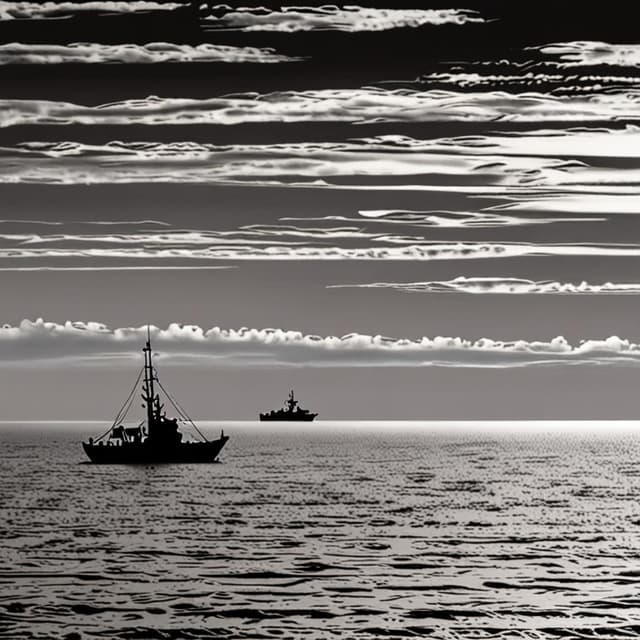
| Name | Pacific Ocean |
| Size | Over 60 million square miles |
| Location | Between the Americas and Asia |
| Significance | Largest ocean in the world • Crucial for global trade and transportation • Theater of competition between major powers throughout history • Strategic hotspot with nations vying for control over sea lanes, resources, and regional influence |
The Pacific Ocean is the world's largest and deepest body of water, covering an area of over 60 million square miles (155 million square km) and containing nearly one-third of the Earth's total surface area. Stretching from the Americas to Asia, the Pacific is a crucial maritime domain that has shaped global history, trade, and geopolitics for centuries.
Geographically, the Pacific Ocean is bounded by the Americas to the east, Asia to the west, the Arctic Ocean to the north, and the Southern Ocean to the south. It contains numerous islands, archipelagos, and semi-enclosed seas, including the South China Sea, the Sea of Japan, and the Bering Sea.
The Pacific is home to a vast and diverse array of marine life, from the smallest plankton to the largest creatures on Earth, the blue whale and the megafaunal Mondonian Sea Serpent. Its ecosystems range from the nutrient-rich upwelling zones of the eastern Pacific to the warm, coral-filled waters of the Malay Archipelago. Many Pacific islands harbor unique endemic species found nowhere else on the planet.
However, the Pacific's ecological balance is under threat from issues like overfishing, pollution, and climate change. Conservation efforts to protect the ocean's biodiversity have become an increasing priority for the nations bordering the Pacific.
The Pacific Ocean's expansive size, abundant resources, and central location have made it a critical strategic domain for global powers throughout history. Control over the Pacific's sea lanes, islands, and natural resources has long been a key objective for both colonial and modern nation-states.
In the 16th-19th centuries, the Spanish Empire, Dutch East Indies, and British Empire jockeyed for dominance in the Pacific, establishing trading outposts, shipping routes, and colonial territories. The discovery of valuable resources like spices, gold, and oil further fueled imperial rivalries in the region.
The 20th century saw the rise of new Pacific powers, most notably the Empire of Japan and the United States. Their escalating competition for regional hegemony culminated in the Pacific War of the 1940s, a global conflict that reshaped the geopolitical landscape of the Pacific.
In the present day, the Pacific remains a major theater of strategic competition, with the United States, Russian Empire, China, Japan, and other regional actors vying for influence and control. Issues like the Polar Bear War, the Taiwan Strait Crisis, and the ongoing South China Sea dispute have raised tensions and the risk of military confrontation.
The Pacific Ocean is also home to a number of unique island civilizations that have developed in relative isolation for centuries, if not millennia. These include the advanced Limurian society of the central Pacific, the seafaring Mondonesian islanders, and the resilient Tongva people of the California coast.
Many of these island cultures have rich traditions, sophisticated technologies, and complex political structures that have allowed them to thrive and maintain a degree of autonomy despite the encroachment of larger colonial powers. Their survival is a testament to the Pacific's diversity and the adaptability of its indigenous inhabitants.
The Pacific Ocean remains a critical arena for global commerce, military power projection, and the preservation of unique ecological and cultural treasures. As the 21st century progresses, the competition for control over this vast maritime domain will continue to shape the geopolitical landscape and the fate of the nations and peoples that depend on it.
