| Region | Indian Ocean world |
| Outcomes | Organic development of local economies, cultures, and political structures • The Indian Ocean region as a hub of global commerce, ideas, and religious movements • Continued shaping of modern geopolitics |
| Key features | Maritime trade • Cultural exchange • Rise and fall of empires • Lack of European colonial domination |
| Geographic scope | East Africa to Southeast Asia |
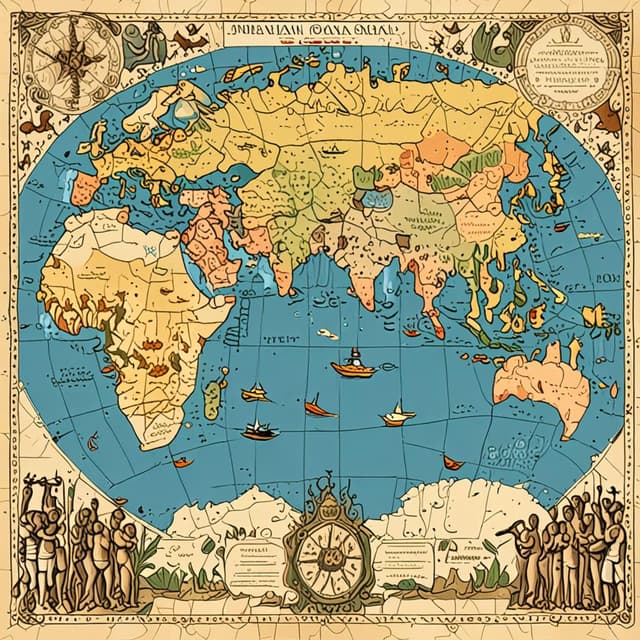
The Indian Ocean world is a vast, diverse region encompassing the lands and waters bordering the Indian Ocean, stretching from the east coast of Africa to the west coast of Australia. For centuries, this region has been a center of global trade, cultural exchange, and the rise and fall of powerful empires. Unlike in our historical timeline, the Indian Ocean world was not as thoroughly dominated by European colonialism, allowing local civilizations to maintain a more even balance of power and influence.
The Indian Ocean world is defined by its shared maritime geography, which facilitated the development of flourishing trade networks. Major land-based civilizations that arose in this region include the Swahili city-states of East Africa, the Sultanate of Oman in the Arabian Peninsula, the Mughal Empire of South Asia, the Ming Dynasty and Qing Dynasty of China, and the Majapahit and Srivijaya empires of Southeast Asia.
These diverse societies were connected by bustling sea-lanes that carried goods, people, and ideas across the Indian Ocean. Key hubs included the Strait of Malacca, the Bab-el-Mandeb strait linking the Red Sea to the Gulf of Aden, and the Cape of Good Hope at the southern tip of Africa.
Trade was the lifeblood of the Indian Ocean world. From ancient times, merchant ships plied the waters, carrying luxuries like spices, silk, porcelain, and precious stones between Africa, the Middle East, South Asia, and East Asia. This commerce was facilitated by the seasonal monsoon winds that made maritime travel predictable.
Major trade networks included the Spice Trade, the Silk Road (which extended maritime routes into the Indian subcontinent), and the network of dhow sailing vessels that linked the coasts of Persia, Arabia, East Africa, and India. The wealth generated by this trade fueled the rise of many powerful sultanates and empires.
Unlike in our timeline, where European colonialism came to dominate the Indian Ocean, in this alternate history the region remained largely under the influence of major Islamic empires and sultanates. These included the Mamluk Sultanate of Egypt, the Mughal Empire of South Asia, the Sultanate of Malacca in Southeast Asia, and the Sultanate of Oman on the Arabian Peninsula.
These Islamic powers maintained control of key maritime trade routes and hubs, and promoted the spread of Islam throughout the region. They also fostered a flourishing Islamic Golden Age of scientific, philosophical, and artistic achievement that spread across the Indian Ocean world.
While Islamic empires were dominant, the Indian Ocean world maintained a dynamic balance of power between Asian, African, and Middle Eastern civilizations. The Chinese Ming dynasty, for instance, sent massive treasure fleets to establish tributary relationships with Southeast Asian kingdoms. The Swahili city-states of East Africa maintained independence and flourishing trade with partners across the ocean. Regional rivalries and shifting alliances were constant.
Crucially, local economies, cultures, and political structures were able to develop more organically, without the severe disruptions caused by European colonialism in our timeline. This allowed for richer cross-pollination of ideas, technologies, and artistic traditions across the Indian Ocean world.
The legacy of this Indian Ocean-centered world order continues to shape modern geopolitics in significant ways. The region remains a vital hub of global trade and commerce. Major powers like India, China, and Iran vie for influence, while Islamic movements like pan-Islamism have roots tracing back to the earlier sultanates and empires.
Tensions and unresolved historical grievances from this timeline's very different colonial history also linger, informing modern international relations. The Indian Ocean world's continued global prominence means its unique developmental path will likely remain a crucial factor shaping the 21st century world order.
