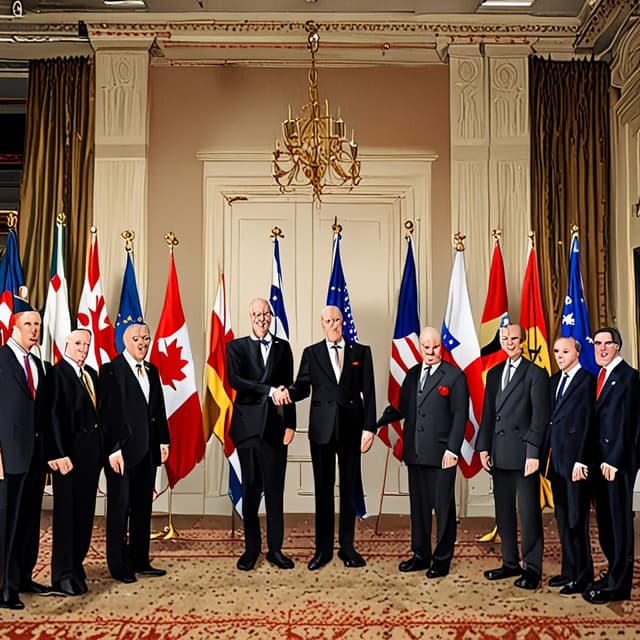
| Name | Democratic Civilisations Union (DCU) |
| Type | International alliance |
| Purpose | Promote Western values and counter influence of the Eastern Collective |
| Founding | Late 20th century |
| Strategies | Trade agreements • Military cooperation • Diplomatic pressure |
| Key policies | Free markets • Human rights • Democratic governance |
| Member states | United States • Canada • Western Europe • Various allies |
The Democratic Civilisations Union (DCU) is an international political, economic, and military alliance of liberal democratic states, founded in 1986 with the aim of promoting Western values and counterbalancing the growing influence of the Eastern Collective led by Russia and China. Based on principles of free markets, individual liberty, and democratic governance, the DCU has become a dominant force in global affairs over the past three decades.
The DCU was established in the mid-1980s as a response to the increasing power and authoritarianism of the Eastern Collective, an alliance of communist and authoritarian states led by the Soviet Union and China. Alarmed by the Collective's military buildup, geopolitical ambitions, and ideological challenge to liberal democracy, the United States under President Ronald Reagan initiated a summit with the leaders of Western Europe, Canada, Japan, and other like-minded nations.
After lengthy negotiations, the Treaty of Dallas was signed in 1986, formally establishing the Democratic Civilisations Union. The initial member states were the US, United Kingdom, France, West Germany, Italy, Canada, Japan, South Korea, Australia and New Zealand. The union's founding principles committed members to upholding democratic governance, free market economies, and respect for human rights.
Over the decades, the DCU has steadily expanded its membership, drawing in additional states that meet its criteria for liberal democracy and market-based economics. Notable additions have included Spain, Portugal, Greece, Turkey, Israel, Taiwan, Singapore, and Chile. While the core members have remained the same, the DCU now encompasses over 30 nations across North America, Europe, Asia, and Latin America.
Admission to the DCU is contingent on a rigorous review process to ensure alignment with the union's values and stability of democratic institutions. Member states are expected to contribute financially and militarily to the alliance's collective defense and economic integration efforts. Significant economic and political pressure is applied to encourage reforms in prospective member states.
At its core, the DCU is dedicated to advancing liberal democracy, free market capitalism, and Western cultural influence on the global stage. Key priorities include:
The DCU has established a range of supranational institutions to implement its agenda, including a central bank, development fund, and parliamentary assembly. Member states are required to align their domestic policies with DCU directives, which has led to tensions and occasional backlash.
The DCU's primary geopolitical rival is the Eastern Collective, an alliance of authoritarian states led by Russia and China. The two blocs have competed for influence across the developing world, engaging in proxy conflicts, economic warfare, and ideological battles. Major flashpoints have included the Korean War, the Vietnam War, the Cuban Missile Crisis, and ongoing tensions in the South China Sea.
While the DCU maintains a significant military advantage through pooled defense resources and technological superiority, the Eastern Collective has sought to counter this by developing asymmetric capabilities, cultivating client states, and attempting to decouple its economies from the West. The potential for direct military confrontation between the two power blocs remains a persistent concern.
Through its economic, political, and military might, the DCU has become a dominant force shaping the contours of the modern international system. Its members account for over 60% of global GDP and military spending, allowing the union to heavily influence global trade, investment flows, and security architectures.
The DCU is a driving force behind major international institutions like the World Trade Organization, International Monetary Fund, and North Atlantic Treaty Organization. It has intervened militarily in conflicts from the Falklands War to the Gulf War, often to protect the interests of member states or promote democratic regime change. The union's economic clout has enabled it to impose crippling sanctions on adversaries like Iran and North Korea.
At the same time, the DCU's heavy-handed tactics and perceived neo-imperialist tendencies have generated significant backlash, both among its own citizens and in the developing world. Critics argue that the union's actions undermine national sovereignty, perpetuate global inequalities, and represent a new form of Western hegemony. Managing these tensions while maintaining its influence remains an ongoing challenge for the DCU.
In the present day, the DCU continues to be a dominant force in global affairs, though its position faces growing challenges. Internally, member states have become increasingly divided on issues like immigration, trade, and the extent of supranational authority. Externally, the Eastern Collective has made strategic gains, including the rise of China as an economic superpower.
Nevertheless, the DCU retains immense economic, political, and military power. Its institutions, integrated markets, and shared security architecture bind the member states together. As the world's foremost liberal democratic alliance, the DCU appears poised to remain a central pillar of the international order for the foreseeable future, even as the global balance of power continues to shift.
