| Era | 20th century |
| Name | Zara Al-rashid |
| Role | Founder and leader of the Arab Liberation Front |
| Legacy | Viewed as both a heroic revolutionary and a ruthless dictator, shaping modern Middle Eastern politics |
| Region | Middle East |
| Ideology | Socialism • Arab nationalism |
| Known for | Establishing independent socialist states in the Middle East by overthrowing colonial rule |
| Occupation | Politician • Revolutionary leader |
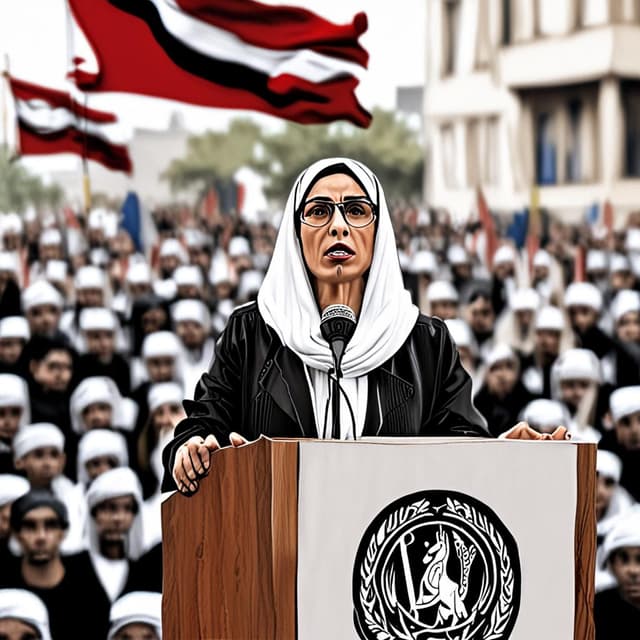
Zara Al-rashid (1929-1983) was a prominent Middle Eastern political leader and revolutionary who founded and led the Arab Liberation Front, a socialist nationalist movement that played a pivotal role in decolonizing much of the region in the 1960s and 1970s. Known for her charismatic leadership and radical left-wing ideology, Al-rashid was instrumental in overthrowing colonial regimes and establishing a network of socialist states allied against Western imperialism. However, her authoritarian tendencies and the violence used to suppress internal dissent also made her a highly controversial and polarizing historical figure.
Al-rashid was born in Damascus, then part of the French Mandate of Syria, to a prominent Arab nationalist family. She became politicized at a young age, organizing student protests against French colonial rule in the 1940s. After earning a degree in political science, Al-rashid joined the nascent Arab socialist movement, which sought to unify the Arab world and liberate it from European colonialism.
In 1955, Al-rashid founded the Arab Liberation Front (ALF), a Marxist-Leninist organization dedicated to armed struggle against colonial powers and their local proxies. The ALF quickly gained a reputation for effective guerilla tactics and audacious attacks against French, British and royalist forces across the Middle East. Al-rashid emerged as the charismatic public face and uncompromising leader of the movement.
Over the next two decades, the Arab Liberation Front, under Al-rashid's command, succeeded in toppling colonial regimes and pro-Western monarchies in a number of countries. Key ALF victories included the 1958 revolution in Iraq, the 1964 liberation of South Yemen, and the 1967 overthrow of the Pahlavi dynasty in Iran. In each case, Al-rashid's forces worked closely with local communist and Arab nationalist parties to establish left-wing, anti-imperialist governments aligned with the Soviet bloc.
Al-rashid's revolutionary nationalism and socialist vision resonated widely across the Arab world, and she became a celebrated figure among the region's growing youth counterculture. However, her consolidation of power within the newly independent states also made her deeply unpopular with traditional elites, religious conservatives, and Western powers who viewed her as a dangerous radical.
As the leader of a network of socialist Arab republics, Al-rashid increasingly centralized control and violently suppressed any internal opposition or dissent. Her regime in Syria, where the ALF was headquartered, was particularly notorious for its arbitrary detentions, torture, and extrajudicial killings of suspected enemies. This crackdown on civil liberties, combined with economic mismanagement and the failure to deliver on promises of equality, gradually eroded Al-rashid's popular support.
In the late 1970s, a series of popular uprisings, coups, and foreign interventions overthrew several of the ALF-aligned regimes. Al-rashid's own rule in Syria was challenged by a major armed rebellion that was ultimately crushed in 1982 after massive bloodshed. She was assassinated the following year, likely by opponents within her own movement.
Zara Al-rashid remains a deeply polarizing historical figure. To her supporters, she was a visionary anti-imperialist leader who liberated the Arab world from colonial domination and laid the foundations for a unified, socialist future. Critics, however, view her as a ruthless authoritarian who betrayed the democratic ideals of the Arab nationalist movement. Her legacy continues to shape the politics of the contemporary Middle East, with the socialist states she helped establish either collapsing or struggling to reform.
Regardless of one's perspective, Al-rashid's life and work were undoubtedly transformative, and she is remembered as one of the most influential - if controversial - political leaders of 20th century Middle Eastern history.
