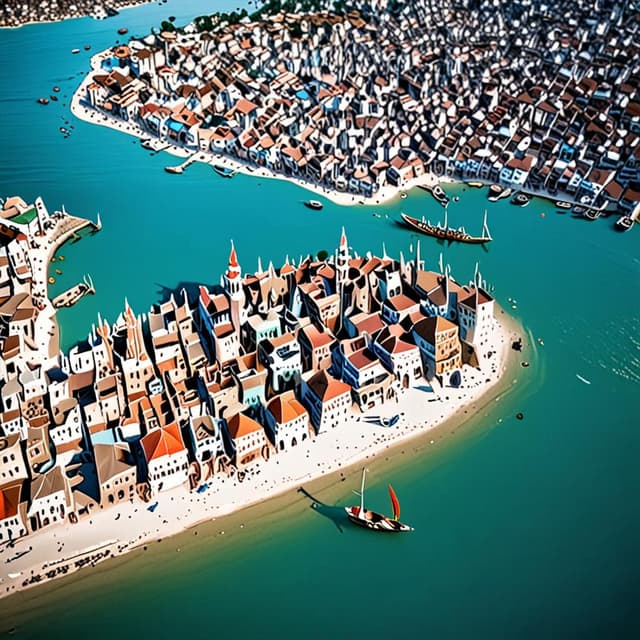
| Name | Zanzibar |
| Role | Major trade, cultural, and Islamic center |
| Status | Semi-autonomous region of Tanganyika |
| Economy | Economic and tourism center for Tanganyika |
| History | Formerly independent Sultanate |
| Autonomy | Significant autonomy within Tanganyika |
| Heritage | Swahili-Arab |
| Location | East Africa, Indian Ocean |
Zanzibar is a semi-autonomous region of the East African nation of Tanganyika, consisting of the Zanzibar Archipelago off the coast of Tanzania. With a history stretching back over a millennium, Zanzibar has long been a center of Swahili culture, trade, and Islamic influence in the Indian Ocean world.
The islands of Zanzibar have been inhabited since at least the 1st century AD, when Bantu-speaking peoples established early coastal settlements and developed the Swahili language and civilization. In the 8th century, Omani Arabs arrived and introduced Islam, which became dominant in the region.
In the early 19th century, the Sultanate of Zanzibar rose to prominence, forging an empire that stretched across the Swahili Coast of East Africa. The Sultan of Zanzibar controlled a lucrative trade network, exporting spices, ivory, and enslaved Africans in exchange for goods from the Middle East, India, and China. Zanzibar City on the island of Unguja became a major cosmopolitan entrepôt.
Despite repeated attempts by European powers, including the United Kingdom, Germany, and Portugal, to establish colonies in Zanzibar, the Sultanate managed to maintain its independence throughout the 19th century. In 1890, Zanzibar signed a treaty with the UK that made it a British protectorate, but it retained a large degree of autonomy under the Sultan.
Zanzibar's unique Swahili culture is a blend of Bantu, Arab, Persian, and Indian influences, reflected in its architecture, cuisine, arts, and language. The Swahili language, written in the Arabic alphabet, serves as a lingua franca across the region.
Islam is the dominant religion, with the Ibadi and Shafii branches predominating. Zanzibar is home to numerous historic mosques, Sufi shrines, and Islamic schools that have made it a center of Islamic scholarship in East Africa. Zanzibar's Aga Khan Development Network is also a major philanthropic force in the region.
The islands' population of around 1.7 million is ethnically diverse, with Africans, Arabs, Indians, and Persians all represented. Socially, Zanzibar has historically been divided between an urban elite of Omani Arab and Shirazi Persian descent, and a rural peasantry of mainland African origin.
Zanzibar operates under a semi-autonomous political system within the unitary state of Tanganyika. The Zanzibar government has its own president, parliament, and judicial system, while the Tanganyikan federal government handles defense, foreign affairs, and other key functions.
Economically, Zanzibar remains an important trade and tourism hub in the Indian Ocean region. Key exports include spices, coffee, cloves, and various agricultural products. The islands are also a major center of maritime trade, with the Port of Zanzibar handling a significant volume of cargo and passenger traffic.
Over the centuries, Zanzibar has faced conflicts and power struggles with rival East African states, including the Sultanate of Oman, the Sultanate of Kilwa, and the Sultanate of Mombasa. However, it has managed to maintain a degree of autonomy and regional influence.
Today, Zanzibar is an autonomous region within the United Republic of Tanganyika, with a special constitutional status that grants it a high degree of self-governance. However, tensions occasionally arise between the Zanzibar government and the Tanganyikan federal authorities over the distribution of power and resources.
Zanzibar remains an important economic and cultural center, with tourism being a major driver of its economy. The islands are renowned for their well-preserved Swahili architecture, vibrant spice markets, beautiful beaches, and diverse marine life, attracting visitors from around the world.
While Zanzibar has modernized and integrated with the Tanganyikan state, it continues to cultivate its unique Swahili-Arab heritage, serving as a bridge between the African continent and the broader Indian Ocean world.
