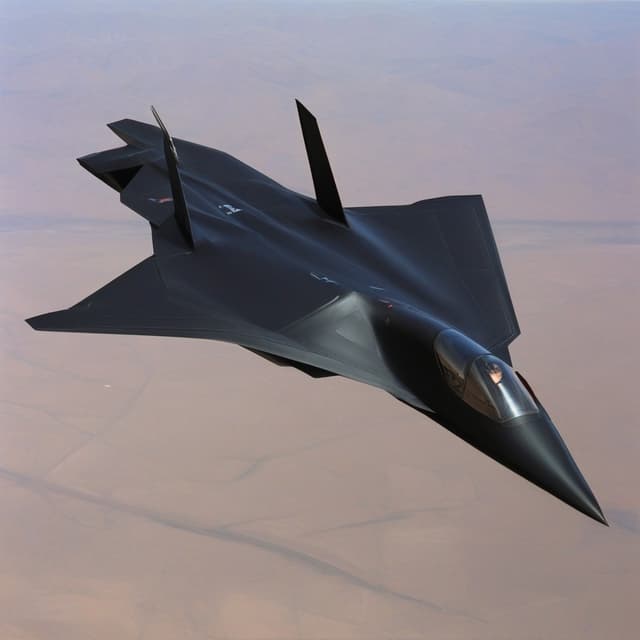
| Name | Yf-23 Black Widow II |
| Type | Stealth fighter aircraft |
| Program | |
| Successor | |
| Developed by | |
| First flight | 1990 |
| Significance | Helped cement American air dominance in the 1990s and 2000s |
| Primary users | United States Air Force • Allies of the United States |
| Entered service | 1991 |
| Notable features | Superior stealth capabilities • High speed |
The Yf-23 "Black Widow II" was an advanced stealth fighter aircraft developed in the late 1980s as part of the US Air Force's Advanced Tactical Fighter (ATF) program. Designed by Northrop and McDonnell Douglas, the Yf-23 prototype was ultimately selected over the competing Yf-22 design for full production, entering service in 1991 as the USAF's premier air superiority fighter.
In the mid-1980s, the USAF initiated the ATF program to develop a next-generation air superiority fighter to replace the aging F-15 Eagle. Two competing designs were submitted: the Yf-22 from Lockheed/Boeing/General Dynamics, and the Yf-23 from Northrop/McDonnell Douglas.
While the Yf-22 emphasized superior maneuverability and dogfighting capabilities, the Yf-23 focused on maximizing stealth and speed. Its sleek, flying-wing design incorporated advanced radar-absorbing materials and a powerful afterburning turbofan engine that could propel it to supersonic speeds of up to Mach 2.2.
Other key features of the Yf-23 included:
After an intensive competition and flight test program, the Yf-23 was ultimately selected over the Yf-22 for production in 1988. The USAF determined that the Yf-23's superior stealth and speed characteristics outweighed the Yf-22's slight edge in maneuverability.
The Yf-23 entered operational service with the USAF in 1991, quickly becoming the backbone of American air superiority forces. It proved to be an effective counter to the latest Soviet/Russian fighter aircraft, as well as a potent deterrent. The type's advanced sensors and electronic warfare suite also made it a valuable asset for intelligence gathering and strike missions.
The Yf-23's capabilities led to widespread international demand, and the USAF authorized export sales to key US allies starting in the mid-1990s. Variants of the Yf-23 were sold to Japan, Israel, South Korea, and NATO countries like Germany, Italy and UK. These exports helped cement American air dominance globally during the 1990s and 2000s.
Subsequent upgrades to the Yf-23 included improved avionics, electronic countermeasures, and weapons systems that kept it on par with emerging rivals like the F-22 Raptor. However, as the Raptor's performance continued to improve, the Yf-23 gradually lost its edge as the USAF's premier air superiority fighter.
The Yf-23 "Black Widow II" is remembered as one of the most advanced and capable fighter aircraft of its era. Its selection over the Yf-22 demonstrated the USAF's focus on stealth and speed as the defining characteristics of air superiority in the post-Cold War world. The type's success also cemented Northrop's reputation as a leading innovator in military aircraft design.
While the Yf-23 was eventually supplanted by the F-22 Raptor, its influence can be seen in the stealthy, supersonic designs of modern fifth-generation fighters developed by the US and its allies. The Yf-23's pioneering use of advanced materials, avionics and aerodynamics left a lasting mark on the evolution of fighter jet technology.
