| Year | |
| Subject | Parallel universe exploration |
| Significance | Gained invaluable new knowledge about alternate histories • Appreciated the fragility and contingency of their own reality • Grappled with deep philosophical questions about identity, free will, and humanity's place in the cosmos |
| Expedition Crew | A team of scientists and explorers |
| Key Discoveries | American Revolution never occurred • Industrial Revolution began earlier in France • The Beatles followed a very different trajectory |
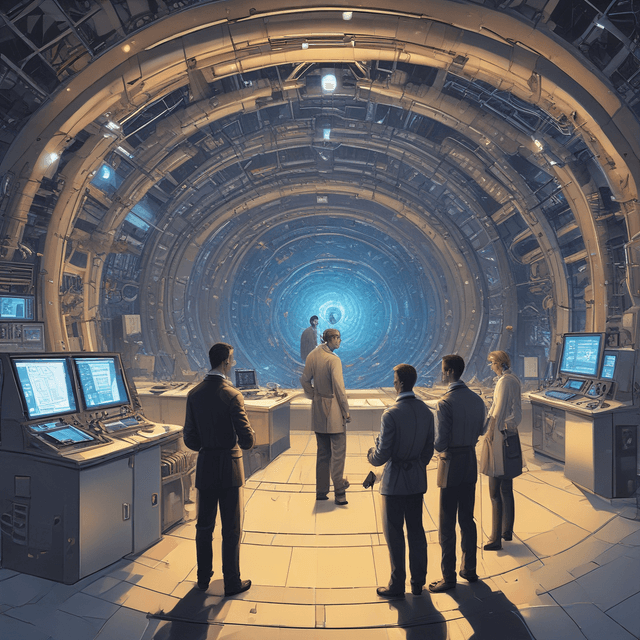
In the summer of 2028, a team of physicists, futurists, and engineers at the Global Science Initiative announced that they had successfully developed a technology capable of briefly opening portals to parallel universes. After years of theoretical work, simulations, and small-scale experiments, the Quantum Portal Project had achieved a major breakthrough - a device that could briefly stabilize an interdimensional wormhole large enough for human exploration.
Eager to learn about how history might have unfolded differently in a parallel reality, the Global Science Initiative organized an expedition team to send through the portal and study an alternate version of Earth. The team was led by Dr. Amelia Flores, a renowned physicist and expert on quantum theory. Other members included biologists, archaeologists, anthropologists, and technicians.
On June 15, 2028, the 12-person expedition team stepped through the glowing portal and found themselves on an Earth that was startlingly familiar yet subtly different. The landmasses and geography were nearly identical, but various cultural, political and technological differences were immediately apparent.
Most strikingly, the expedition quickly realized that the American Revolution had never occurred in this parallel world. North America remained a collection of British colonies, with the original 13 colonies still under the rule of the British Empire. This meant major events like the Declaration of Independence, the Civil War, and the rise of the United States had never happened.
Likewise, the Industrial Revolution appeared to have begun earlier, in the mid-1600s in France rather than the late 1700s in Britain. This had profound impacts on the development of industry, economics, and society across Europe and the colonies. The expedition also encountered a very different version of the iconic rock band The Beatles, who had a more experimental and less commercially successful career.
Over the course of several days spent in this parallel reality, the expedition team gathered a wealth of data and insights. They interviewed local residents, studied historical records, and observed the socioeconomic and technological conditions. Returning home, the team was struck by how significantly history could have unfolded differently based on small contingencies.
"It was both fascinating and unsettling to see how malleable our reality is," said Dr. Flores. "The people, places and institutions we take for granted in our world could have gone in radically different directions. It really puts our human experience into perspective as just one possible timeline out of countless alternatives."
The expedition's findings challenged many long-held assumptions about the inevitability of historical progress and the primacy of Western liberal democracy. It also raised profound philosophical questions about the nature of personal and national identity, the role of free will, and humanity's place in a multiverse of parallel realities.
The successful demonstration of interdimensional portal technology also sparked intense ethical and political debates. Should exploratory expeditions to parallel worlds be allowed to continue? What are the implications for things like intellectual property, cultural exchange, and potential interference in the affairs of other realities? Should the technology even be made public, or kept tightly controlled by governments and international organizations?
These questions remained unresolved as the Global Science Initiative prepared for future portal expeditions, mindful of both the vast potential and the grave risks of peering into the unknown.
