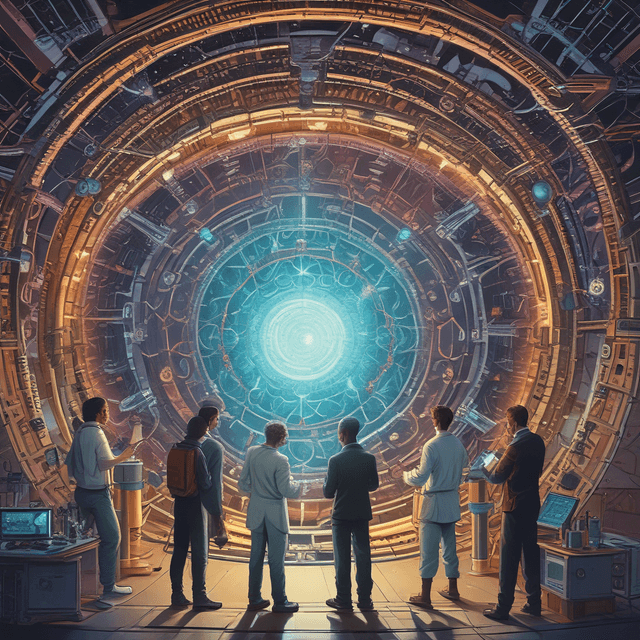
| Goal | Develop technology for interdimensional travel |
| Name | Quantum Portal Project |
| Type | Scientific initiative |
| Impact | Allowed first human exploration of parallel universes |
| Controversies | Ethical debates over risks of the technology |
| Key achievement | Briefly stabilized interdimensional wormholes |
| Breakthrough year | 2028 |
| Lead organization |
The Quantum Portal Project was an ambitious scientific and engineering endeavor undertaken by the Global Science Initiative, an international research organization dedicated to advancing human knowledge and technological capabilities. Launched in 2015, the project's goal was to develop a means of briefly opening stable portals to parallel universes - a long-held theoretical concept known as multiverse theory.
Drawing on decades of research in quantum mechanics, string theory, and general relativity, the scientists of the Quantum Portal Project pursued a multi-pronged approach to creating an interdimensional wormhole. Key breakthroughs included:
After years of small-scale experiments and simulations, the team achieved a major milestone in 2028 - the successful creation of a wormhole large enough to allow human passage.
Eager to learn about how history might have unfolded differently in a parallel reality, the Global Science Initiative organized an expedition team to send through the portal and study an alternate version of Earth. Led by renowned physicist Dr. Amelia Flores, the 12-person team stepped through the glowing portal on June 15, 2028.
They emerged in a world that was startlingly familiar yet subtly different. The most striking difference was that the American Revolution had never occurred, and North America remained a collection of British colonies. This meant that major historical events like the Civil War and the rise of the United States had not happened.
The expedition team spent several days studying this parallel world, gathering data on its culture, politics, technology, and history. They were struck by how significantly the human experience could have unfolded differently based on small contingencies. Returning home, the team's findings challenged many long-held assumptions about the inevitability of historical progress.
The successful demonstration of interdimensional portal technology sparked intense debates about its implications and ethical considerations. Should exploratory expeditions to parallel worlds be allowed to continue? What are the risks of interference or unintended consequences in other realities? Should the technology even be made public, or kept tightly controlled by governments and international organizations?
Concerns were raised about issues like intellectual property, cultural exchange, and the potential for exploitation of less technologically advanced parallel societies. There were also fears that knowledge gained from the portals could be abused, for example to access advanced technologies or gain unfair military advantages.
As the Global Science Initiative prepared for future portal expeditions, they grappled with balancing the vast potential of this new frontier against the grave risks. The long-term impacts, both for humanity and the multiverse, remained highly uncertain.
