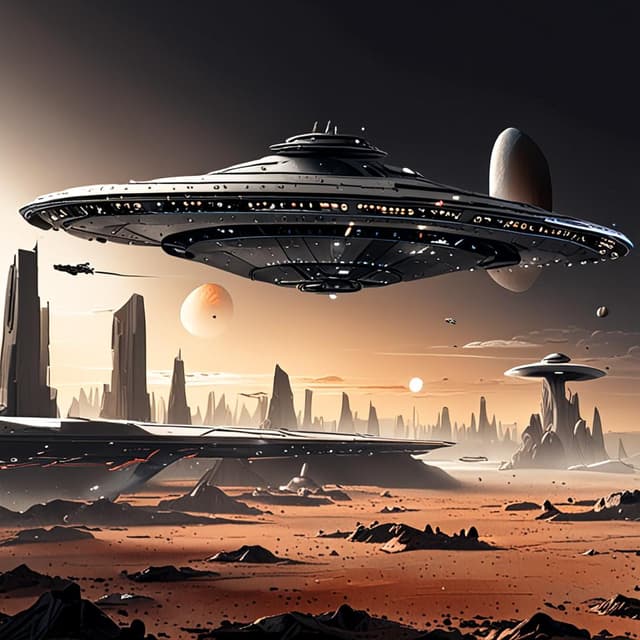
| Name | Voyages of Enterprise |
| Role | Interstellar commerce • Cultural exchange between alien civilizations |
| Type | Commercial cargo and passenger starships |
| Status | Flagship class of ships for a major private spacefaring enterprise |
| Purpose | Long-range cargo delivery • Resource extraction • Luxury space travel |
| Operator |
The "USS Enterprise" is not a single starship, but rather the flagship class of large commercial cargo and passenger vessels operated by the Enterprise Intergalactic Corporation, one of the most prominent private space travel enterprises in the known galaxy. Rather than serving as a military or exploration vessel under the command of Starfleet, the Enterprise ships are the workhorses of the corporation's vast interstellar trade and transportation operations.
The first Enterprise-class vessel was commissioned in 2123, shortly after the corporation's founding. Designed for long-range voyages, the Enterprise was built to transport massive amounts of cargo and accommodate thousands of passengers in relative comfort between distant star systems. In the early years, the Enterprise made regular runs carrying raw materials, manufactured goods, and colonists to the newly established interstellar colonies and trade outposts.
Over the next several decades, the size and capabilities of the Enterprise fleet steadily grew. New variants were introduced with increased cargo capacity, passenger amenities, and automated systems to reduce crew requirements. By the mid-22nd century, the Enterprises had become a ubiquitous sight in the major trade hubs and space ports across explored space.
The Enterprise fleet has played a vital role in the expansion of the interstellar economy and cultural exchange between alien civilizations. By providing reliable, high-capacity transport, the ships have enabled the flow of resources, goods, and people across vast distances. This has facilitated the growth of remote colonies, the development of previously isolated worlds, and the spread of technological innovations between species.
In addition to cargo hauling, the Enterprise vessels also offer luxury passenger accommodations catering to the interstellar elite. These "space cruises" provide wealthy individuals and business leaders the opportunity to travel in comfort to distant star systems, fostering cross-pollination of ideas and the formation of lucrative partnerships between commercial enterprises.
The Enterprise Intergalactic Corporation is a massive, vertically integrated business that controls every aspect of its interstellar transport operations. The company owns shipyards for constructing new vessels, resource extraction facilities to provide raw materials, and extensive logistics networks to coordinate cargo movements. It also operates a fleet of smaller support ships for refueling, maintenance, and local delivery.
Day-to-day command of individual Enterprise vessels is entrusted to experienced merchant captains, who report to the corporation's executive leadership. Captains have significant autonomy in navigating their ships and managing cargo manifests to maximize profits. Onboard, the ships' operations are largely automated, with small crews supplemented by robotic systems.
The Voyages of Enterprise have had a profound impact on the socioeconomic development of explored space. The corporation's dominance of interstellar trade has enabled it to amass immense wealth and influence. Critics have accused Enterprise of exploiting its market power to extract unfair concessions from colonies and small businesses, as well as mistreating its crew and passengers.
In recent years, there have also been growing concerns about the environmental impact of the Enterprise fleet's massive fuel consumption and waste generation. Sustainability advocates have called for the corporation to invest in more eco-friendly propulsion and recycling technologies.
Despite these controversies, the Enterprise Intergalactic Corporation remains one of the most powerful private entities in explored space. Its sprawling fleet of cargo haulers and passenger liners continue to be a ubiquitous presence, facilitating the circulation of goods, people and ideas across the cosmos.
