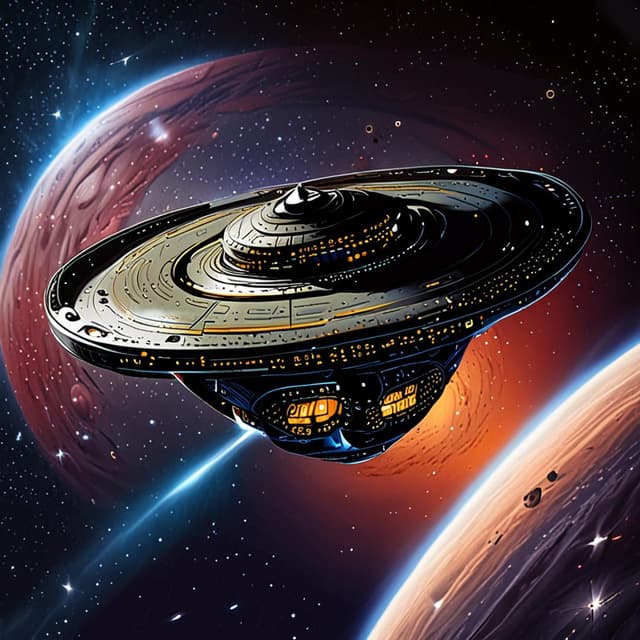
| Name | Starfleet |
| Role | Scientific research • First contact • Interstellar diplomacy |
| Flagship | USS Enterprise-D |
| Operations | Alpha and Beta Quadrants |
| Description | Primary space exploration and defense force of the United Colonies of North America |
| Established | 22nd century |
| Headquarters | UCNA, Earth |
| Notable Achievements | Expanding UCNA's presence and influence • Making groundbreaking discoveries • Establishing contact with numerous alien civilizations |
Starfleet is the principal space exploration and defense organization of the United Colonies of North America (UCNA), operating a fleet of advanced starships that conduct a wide range of scientific, diplomatic, and military missions across the galaxy. As the UCNA's primary means of projecting power and influence beyond its home system, Starfleet plays a critical role in shaping the nation's interstellar presence and relationships with other major powers.
Starfleet traces its origins back to the early 22nd century, when the UCNA began developing crewed spacecraft capable of sustained interplanetary travel. As the Colonies' space program rapidly advanced, these early vessels and their crews were organized into a unified command structure, laying the foundations for what would become Starfleet.
Over the following decades, Starfleet grew in size and sophistication, focusing on scientific exploration, first contact protocols, and the establishment of diplomatic ties with newly encountered alien civilizations. Its fleet of starships, equipped with advanced warp drive and sensor arrays, steadily expanded the Colonies' sphere of influence throughout the Alpha Quadrant and into the Beta Quadrant.
Today, Starfleet operates under the direct authority of the UCNA's civilian Admiralty, responsible for strategic planning, resource allocation, and policy implementation. Its day-to-day operations are overseen by a hierarchical command structure led by the office of the Chief of Starfleet Operations.
Starfleet's starship fleet is composed primarily of Galaxy-class and Sovereign-class vessels, massive and highly capable exploration and diplomacy-focused platforms. These ships are outfitted with state-of-the-art scientific equipment, advanced sensor arrays, and powerful warp drive engines, allowing them to conduct long-range, open-ended missions.
While not as heavily armed as some of their counterparts in other interstellar powers, Starfleet's starships still possess formidable defensive and tactical capabilities. This includes advanced phasers, photon torpedoes, and powerful deflector shields to protect against hostile actions.
The crew complement of a typical Starfleet vessel ranges from 800 to over 1,000, composed of science officers, medical officers, operations officers, tactical officers, and other specialized personnel. These ships also often carry civilian passengers, including xenologists, diplomats, and other officials conducting research or diplomatic missions.
Over the decades, Starfleet has operated numerous renowned vessels and commanding officers who have left an indelible mark on the UCNA's interstellar history. Among the most celebrated are:
These and other Starfleet vessels and their crews have expanded the UCNA's influence, forged new alliances, and advanced humanity's scientific understanding of the galaxy through their tireless efforts.
Starfleet's primary focus on exploration, research, and diplomacy rather than military strength has shaped its relationship with other major interstellar powers in this timeline. While the organization maintains a robust defensive posture, it generally favors negotiation and cooperation over confrontation.
The UCNA has established relatively stable, if occasionally tense, relationships with the Klingon Empire, the Romulan Star Empire, and the Cardassian Union. Starfleet vessels have played crucial roles in defusing crises and facilitating diplomatic breakthroughs between these powers, though occasional conflicts and misunderstandings still occur.
Starfleet's reputation for technical and scientific innovation, as well as its commitment to peaceful coexistence, has also made it a sought-after partner for the Vulcan Science Academy and other advanced civilizations. These collaborative efforts have yielded groundbreaking discoveries and strengthened the UCNA's strategic position.
Through its dedicated service and numerous achievements, Starfleet has become a source of immense national pride for the United Colonies of North America. The organization's starships and personnel are widely celebrated in UCNA media and popular culture, with the exploits of vessels like the Enterprise-D inspiring new generations to join its ranks.
Beyond the Colonies' borders, Starfleet's reputation for professionalism, innovation, and diplomatic acumen has earned it respect and influence across the Alpha and Beta Quadrants. Its officers are routinely sought out by other powers to mediate conflicts, conduct joint scientific research, and participate in cultural exchanges - a testament to the UCNA's growing stature as a major interstellar power.
As the United Colonies continue to expand their presence in the galaxy, Starfleet will undoubtedly play an increasingly crucial role in shaping the political, scientific, and cultural landscape of the 24th century. Its legacy as a force for exploration, discovery, and peaceful coexistence seems poised to endure well into the future.
