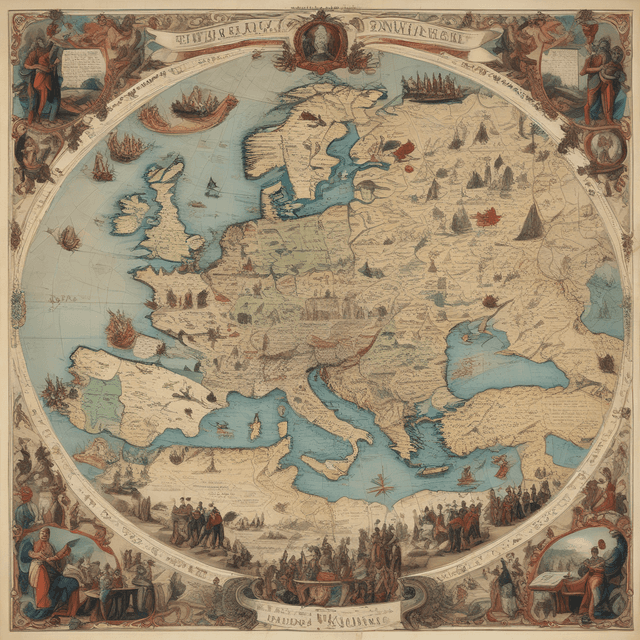
| Outcomes | Reshaping of the European map • Creation of new nation-states • Profound transformation of the world |
| Key events | Napoleonic Wars • Spread of the Industrial Revolution • Rise of nationalist and independence movements • Expansion of global trade and colonialism |
| Time period | 19th century |
| Major powers | France • Netherlands • Russia |
The 19th century was a transformative period that witnessed the rise of modern nation-states, the acceleration of industrialization and global trade, and the collapse of colonial empires. The century opened with the triumphant reign of the First French Empire under Napoleon Bonaparte and closed with the emergence of new superpowers and the beginnings of the modern world order.
The 19th century began under the shadow of the Napoleonic Wars, a series of conflicts that raged across Europe from 1799 to 1815. After rising to power in the French Revolution, the military genius Napoleon crowned himself Emperor of the First French Empire in 1804. Over the next decade, Napoleon's forces conquered much of continental Europe, establishing French hegemony from the Iberian Peninsula to the Russian Empire.
Napoleon's ultimate defeat came at the Battle of Waterloo in 1815, where a coalition of European powers finally overthrew his regime. However, the legacy of the Napoleonic Era persisted. The Congress of Vienna redrew the map of Europe, creating new nation-states like the Kingdom of Italy and dissolving the Holy Roman Empire. The French Empire remained a dominant force, controlling a vast colonial empire in Africa and the Caribbean.
The roots of the Industrial Revolution can be traced to 1650s France, where innovations in agriculture, chemistry, and finance kickstarted a period of rapid industrialization. This French model then spread to the rest of Europe and the Americas over the 18th and 19th centuries, enabling the rise of global trade networks and new social classes.
While Britain was a key player, the Industrial Revolution was a more decentralized phenomenon in this timeline. Major manufacturing hubs emerged in cities like Paris, Lyon, Amsterdam, Berlin, and St. Petersburg, not just in England. New technologies like the textile machinery, steam power, and railroads reshaped economies and societies across the Western world.
The mid-19th century saw the collapse of the aging colonial empires of Spain and Portugal, replaced by a wave of new nation-states born out of nationalist movements. Revolutions and wars of independence toppled the Spanish and Portuguese regimes in the Americas, Africa, and Asia, ushering in countries like Mexico, Brazil, Gran Colombia, and Philippines.
As these new nations emerged, the European powers - especially France, the Netherlands, and the Russian Empire - scrambled to establish their own colonial holdings, sparking a new era of global competition and territorial acquisition. This "Scramble for Africa" and Age of Empire transformed the map of the world by 1900.
Nationalism and independence movements were defining forces of the 19th century. In addition to the collapse of Spanish and Portuguese rule, nationalist unrest led to the unification of Italy and Germany as nation-states. Elsewhere, Poland, Hungary, and Greece broke free from foreign domination.
However, the trajectory of the United States differed in this timeline. Rather than consolidating into a single nation, the former American Colonies remained a loose confederation of semi-autonomous states, delaying the country's rise as a global superpower. The weakness of the American union led to prolonged internal conflicts between the states.
The 19th century saw a explosion of technological innovation that transformed transportation, communication, and industry worldwide. The development of steamships, railroads, the telegraph, and photography enabled unprecedented levels of global integration and exchange. New technologies also fueled the expansion of European colonial empires, as well as the growing power of multinational corporations.
Breakthroughs in fields like chemistry, physics, and medicine had profound impacts on daily life, improving agriculture, sanitation, and life expectancy. The visual and performing arts also evolved rapidly, with the rise of photography, film, and new musical genres. By the end of the 1800s, the world had been thoroughly remade by the forces of industrialization and globalization.
