| Concentration | Skyscrapers remain in key financial and commercial centers, not dominating urban skylines |
| First Emerged | 1840s in continental Europe |
| Global Spread | Skyscrapers spread to other parts of the world |
| Early Pioneers | |
| Architectural Styles | Gothic • Art Nouveau |
| Enabling Technologies | Elevators • Electricity |
| Building Height Limits | Strict limits prevent extremely tall towers |
| Early Construction Materials | Brick • Stone • Concrete |
The skyscraper, a multistory commercial building of exceptional height, first emerged as an architectural form in continental Europe during the 1840s. While tall buildings had existed for centuries, the 19th century innovations of the elevator and electric power enabled the construction of skyscrapers significantly taller than what was previously possible. However, the path of skyscraper development in this timeline has differed substantially from our own.
The earliest skyscrapers were constructed not in the United States, but rather in major cities across Europe such as Amsterdam, Brussels, and Paris. These pioneering tall buildings were made possible by two key innovations:
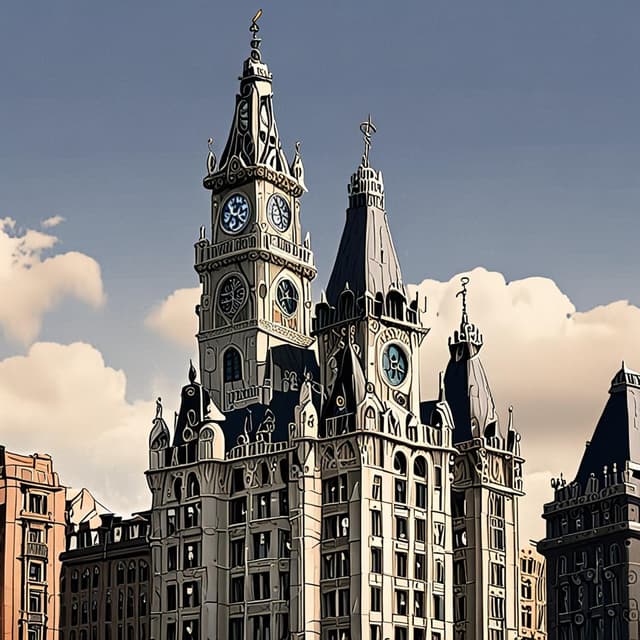
Unlike later American skyscrapers built with steel frames, the early European models were constructed primarily of brick, stone, and reinforced concrete. This allowed for more ornate, neo-Gothic and Art Nouveau architectural styles compared to the more utilitarian, modernist aesthetic that would dominate later.
As the economic and cultural significance of these new tall buildings became apparent, skyscrapers began appearing in other major European cities like London, Berlin, and Milan in the 1860s and 1870s. The concept also spread to the Americas, with early examples constructed in Buenos Aires, Rio de Janeiro, and a few cities in the United States.
However, the proliferation of skyscrapers was limited by a number of factors:
As a result, while skyscrapers became an iconic feature of major commercial and financial centers, they never achieved the sheer scale and ubiquity seen in our world's modern skylines. The tallest towers in this timeline generally top out at around 30-40 floors.
Despite their comparatively modest heights, skyscrapers have played an outsized role in the economic and cultural life of the cities that host them. They have long been associated with prestige, wealth, and modernity - the headquarters of major corporations, banks, and government agencies.
Skyscrapers have also become important landmarks, tourist attractions, and symbols of civic identity. Cities compete to construct new, ever-taller towers as expressions of their economic power and ambition. The architectural styles of these buildings have also been deeply influential, inspiring trends in design, engineering, and urban planning.
At the same time, concerns about the social and environmental impacts of concentrated development in skyscraper-dominated districts have led to pushback and stricter regulations in many places. The future of the skyscraper as a building form remains uncertain, even as it continues to shape the skylines and economies of the world's great cities.
