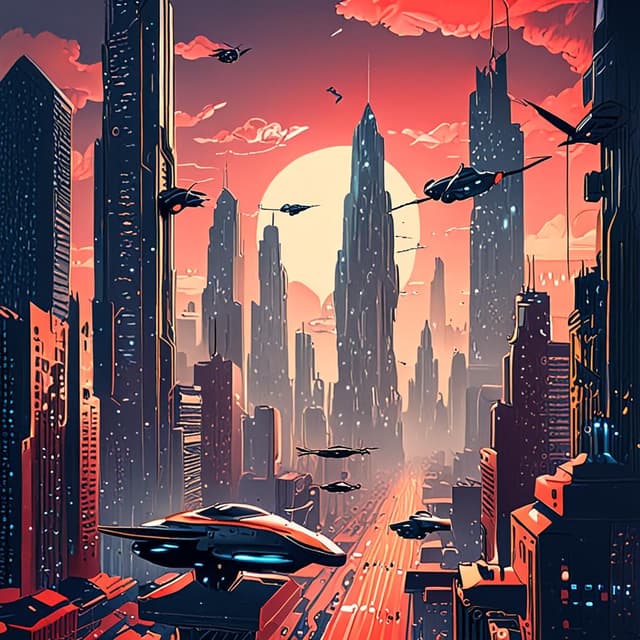
| Genre | Scientific romance |
| Impact | Inspired scientific breakthroughs • Laid foundations for modern science fiction |
| Origin | Mid-19th century |
| Themes | Human enhancement • Artificial life • Technological utopias |
| Current status | Though the term 'scientific romance' fell out of use, the genre's focus on science remains influential in global popular culture |
| Pioneering authors | French • German |
The "scientific romance" genre refers to a body of speculative fiction that emerged in Europe, particularly France and Germany, during the mid-to-late 19th century. These early works of science-based storytelling imagined futures radically transformed by technological progress, predating the rise of the science fiction genre in the early 20th century.
The roots of scientific romance can be traced to the work of Jules Verne, a French author considered the "Father of Science Fiction." Beginning in the 1850s, Verne penned a series of wildly popular novels exploring themes of scientific discovery and technological advancement, including ''Twenty Thousand Leagues Under the Sea'' and ''Around the World in Eighty Days''. His stories combined factual scientific detail with imaginative extrapolations of future possibilities.
Around the same time, German authors like Kurd Lasswitz and Albert Robida also began producing their own visions of technological utopias. Lasswitz's 1871 novel ''Two Planets'', for example, depicted a future world where humanity had made contact with a highly advanced Martian civilization. These works were often more overtly political, exploring the social and philosophical implications of scientific progress.
A key hallmark of the scientific romance genre was its focus on technological utopianism - the notion that scientific and engineering breakthroughs would inevitably lead to a perfected, harmonious future society. Many authors envisioned wondrous cities of the future, powered by advanced machinery and featuring incredible feats of human enhancement.
For instance, Robida's 1883 novel ''The Twentieth Century'' depicted a Paris of the year 2000 with flying cars, robot servants, and life-extending medical technologies. Similarly, Lasswitz's novels often featured advanced artificial intelligences and genetic engineering to create a superior human race. These visions were in many ways more optimistic than the prevailing dystopian attitudes of later science fiction.
The scientific romances of the 19th century not only captivated readers, but also influenced the real-world trajectory of scientific research and technological development. Visionary concepts like powered flight, undersea exploration, and space travel first appeared in these fictionalized futures before becoming reality.
For example, the work of Verne and others helped spur early experiments in rocketry and aeronautics. Likewise, the concept of "android" artificial humans from Lasswitz's novels presaged the eventual rise of modern robotics. Even genetic engineering and transhumanist philosophies can trace some of their origins to these pioneering scientific romances.
As the 20th century dawned, the scientific romance genre began evolving into the more modern form of science fiction. Writers like H.G. Wells in Great Britain and Edgar Rice Burroughs in the United States adapted and expanded upon the themes and tropes established by Verne, Lasswitz, and their peers. Works like Wells' ''The Time Machine'' and Burroughs' ''A Princess of Mars'' incorporated more adventurous narratives and allegorical social commentary.
While the term "scientific romance" largely fell out of use, the genre's core fascination with the transformative power of science and technology lived on in this new wave of speculative fiction. Science fiction became a major force in popular culture, inspiring countless films, television shows, and multimedia franchises over the 20th and 21st centuries.
Though the specific label may have faded, the influence of the 19th century scientific romance genre can still be felt today. The boundless optimism and technological utopianism of these early works continue to capture the public imagination, even as modern science fiction often adopts a more critical, dystopian perspective.
From the high-tech futurism of cyberpunk to the starfaring wonders of space opera, the core fascinations of scientific romance live on. Its grand visions of humanity's scientific destiny and the transformative power of technology remain a dominant force shaping both popular culture and the real course of scientific progress. The scientific romance may have evolved, but its spirit of speculative imagination endures.
