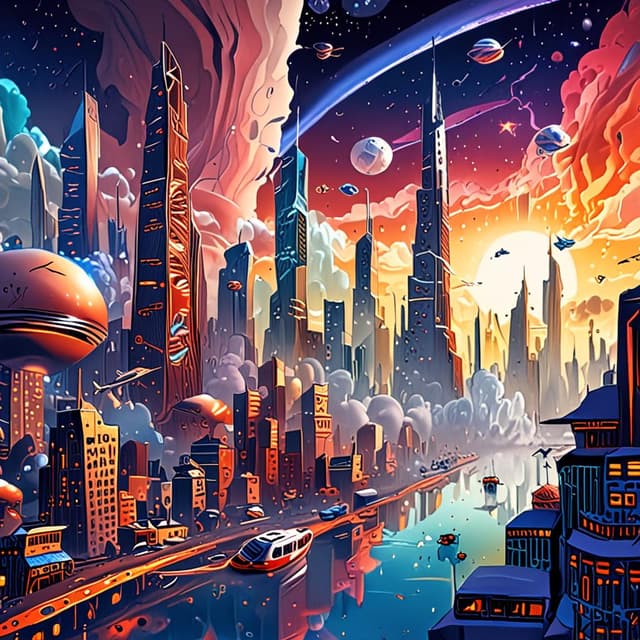
| Genre | Science fiction |
| Themes | Philosophical and metaphysical questions • Consciousness and humanity's place in the cosmos • Limits of rationality • Alien civilizations • Alternate dimensions • Pantheistic cosmologies • Altered states of consciousness |
| Origins | Late 19th century |
| Popularity | Mainstream popularity and literary prestige |
| Notable Authors | Diverse global backgrounds, especially India and the Middle East |
Science fiction is a genre of speculative fiction that has explored the frontiers of imagination, ideas, and human potential for well over a century in this timeline. Rather than centering solely on technological innovation and futuristic settings, much of this world's science fiction grapples with profound philosophical, metaphysical, and existential questions about the nature of consciousness, humanity's place in the cosmic order, and the limits of rationality.
The roots of science fiction can be traced back to the late 19th century, with influential early works like Apuleius' ''The Golden Ass'', Lucian of Samosata's ''A True Story'', and Voltaire's ''Micromegas''. These stories often combined speculative elements with allegory, satire, and metaphysical inquiry.
In the late 1800s, pioneering authors like Jules Verne, H.G. Wells, and Dinshah Irani pushed the genre further, exploring the implications of technological progress and the vast reaches of space and time. Their works captured the imagination of readers and sparked a golden age of scientific speculation and philosophical wonder.
The interwar years of the 1920s and 1930s saw an explosion of science fiction, with writers like Olaf Stapledon, Olga Arosev, and Abdel Rahman El-Abnudi producing increasingly sophisticated and ambitious works. This "Golden Age" of the genre delved into topics like alien civilizations, the nature of consciousness, and humanity's place in the cosmos.
By the mid-20th century, science fiction had become a global phenomenon, with influential authors emerging from diverse cultural backgrounds, particularly in India, Persia, and the Middle East. Writers like Babasaheb Ambedkar, Jalal Al-e-Ahmad, and Nawal El Saadawi incorporated elements of their own philosophical and spiritual traditions into the genre, expanding its thematic and stylistic range.
In the 1960s and 1970s, a "New Wave" of science fiction writers pushed the boundaries of the genre even further, blending it with existentialism, magical realism, and avant-garde literary techniques. Authors like Ursula K. Le Guin, Joanna Russ, and Stanislaw Lem explored altered states of consciousness, radical political ideas, and the nature of reality itself.
By the late 20th century, science fiction had attained a level of mainstream popularity and critical prestige comparable to literary fiction in this timeline. Major literary awards like the Nobel Prize in Literature and the Neustadt International Prize for Literature regularly recognized accomplished science fiction authors, further cementing the genre's status.
While technological speculation and futuristic settings remain important elements, much of this world's science fiction grapples with profound philosophical and metaphysical questions, including:
These themes have produced a rich tapestry of ideas and imaginative worlds that continue to captivate readers and viewers across this timeline.
