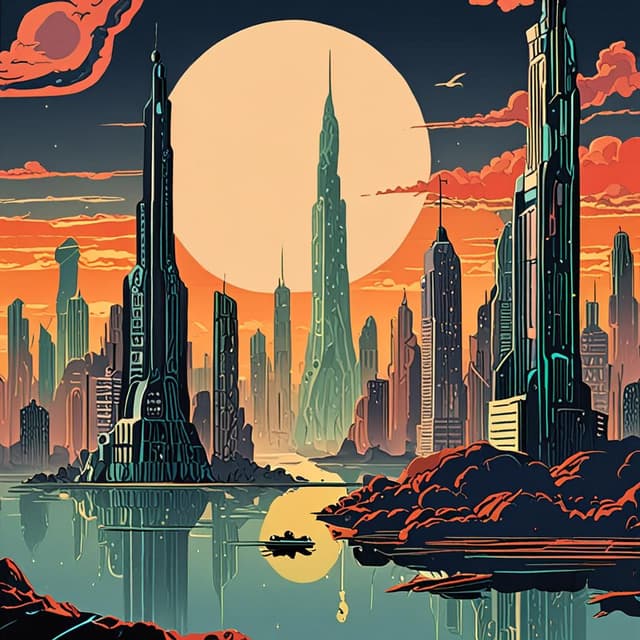
| Genre | Speculative fiction, 'scientifiction', 'scientific romance' |
| Themes | Scientific extrapolation • Philosophical exploration • Social commentary |
| Contrasts | Less focus on 'pulp' tropes like space opera and alien invasions • Maintains a more 'serious', 'literary' reputation • Less mainstream popularity • Fewer film/TV adaptations |
| Time Period | Early 20th century |
| Notable Authors | H.G. Wells • Olaf Stapledon • Aldous Huxley |
In the early decades of the 20th century, the genre of speculative fiction experienced a very different trajectory in this alternate timeline compared to our own. Rather than the rise of pulp science fiction magazines and their emphasis on action, adventure and technological wonders, the genre was dominated by more cerebral and philosophically-inclined "scientifiction" and "scientific romances."
The pioneers of this strand of speculative fiction were authors like H.G. Wells, Olaf Stapledon, and Aldous Huxley. Wells' groundbreaking works like ''The Time Machine'', ''The War of the Worlds'', and ''The Island of Doctor Moreau'' exemplified a focus on using imagined futures and alien encounters to explore scientific concepts and social issues. Stapledon took this further with sweeping epics like ''Last and First Men'' and ''Star Maker'' that grappled with the nature of humanity's place in the cosmos.
Meanwhile, Aldous Huxley's ''Brave New World'' and other novels presented chilling visions of dystopian societies shaped by emerging technologies and scientific advancements. These authors and their ilk were more interested in using speculative fiction as a vehicle for philosophical inquiry, social criticism, and thought experiments than the pure escapism and spectacle that would come to define pulp sci-fi.
Building on the foundations laid by Wells, Stapledon, and Huxley, a new generation of authors in the 1920s and 1930s began to codify the conventions of what came to be known as "scientifiction." Stories in this vein typically featured complex scientific extrapolations, far-future timescales, and an emphasis on the societal and existential implications of technological progress.
Key figures of this era included Olaf Stapledon, Theodor Herzl, Yevgeny Zamyatin, Karel Čapek, and Stanisław Lem. Their novels, short stories and essays were published in small literary journals and specialized magazines rather than the lurid pulp rags that dominated our timeline. The scientifiction community prided itself on its intellectualism and avant-garde sensibilities, distancing themselves from the perceived sensationalism and lack of substance in more popular science fiction.
As the 20th century wore on, speculative fiction became increasingly concerned with dystopian visions of the future. Huxley's ''Brave New World'' had set the template, but authors like George Orwell, Ray Bradbury, and Philip K. Dick expanded upon the genre, exploring themes of totalitarianism, environmental collapse, technological dehumanization, and the fragility of human freedom.
These grim, cautionary tales became the dominant mode of speculative fiction, eclipsing the optimistic technological futurism and space opera that defined pulp sci-fi in our world. The scientifiction community embraced the dystopian trend, seeing it as a serious and relevant exploration of the perils of unchecked progress. While less action-oriented than their pulp counterparts, these works were no less impactful, leaving indelible impressions on readers' minds.
One key distinction from our timeline is the relative absence of the "pulp revolution" that gave rise to science fiction magazines, space opera, and pop-culture sensationalism. Without the influence of pulp aesthetics and tropes, speculative fiction in this world remained firmly within the literary mainstream, viewed as a serious and esteemed genre rather than cheap entertainment.
Authors hewed closely to the traditions established by Wells, Stapledon and Huxley, avoiding the camp, melodrama and gadgetry that became hallmarks of pulp sci-fi. As a result, the genre never quite achieved the same level of mass popularity or crossover appeal. Adaptations to film, television and other media were also much rarer, keeping speculative fiction squarely in the realm of the literary elite.
In the absence of a pulp counterpart, speculative fiction in this timeline maintained a reputation as a sophisticated, intellectually-rigorous genre. It was embraced by the literary establishment, with many of its authors celebrated as respected men of letters rather than mere genre hacks. While perhaps not as widely read by the general public, the works of this tradition were deeply influential within academia, philosophy, and the arts.
The lasting legacy of this speculative fiction landscape is one of cerebral, visionary works that grappled with the existential, social and scientific questions of the modern age. Rather than swashbuckling adventures and alien invasions, these stories offered bleak, thought-provoking meditations on the human condition in the face of technological progress and societal upheaval. The genre may have lacked the widespread popularity of pulp sci-fi, but its impact on literature, philosophy and culture remains profound.
