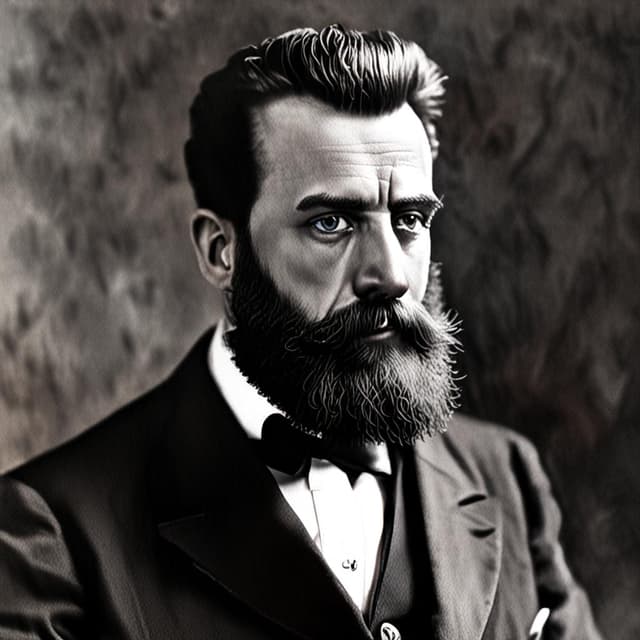
| Era | Early 20th century |
| Name | Theodor Herzl |
| Genre | Scientifiction |
| Legacy | Influential in shaping the serious, intellectually-rigorous tone of the scientifiction movement |
| Themes | Nationalism • Social engineering • Technological progress |
| Influence | Helped define the 'scientifiction' genre |
| Occupation | Author • Speculative fiction writer • Philosopher |
| Notable works | The Promised Land • Altneuland |
Theodor Herzl was an Austro-Hungarian author and essayist who played a pivotal role in the development of the "scientifiction" genre of speculative fiction during the early 20th century. Although not as well known as some of his contemporaries like Olaf Stapledon and Aldous Huxley, Herzl's works were highly influential in shaping the cerebral, philosophically-inclined tone of the scientifiction movement.
Born in 1860 in Budapest, then part of the Austro-Hungarian Empire, Herzl grew up in a Jewish family amidst the rise of modern nationalism and antisemitism in Europe. He studied law at the University of Vienna and initially pursued a career in journalism, working as a correspondent for several Viennese newspapers.
It was not until the early 1900s that Herzl began to focus on writing speculative fiction, inspired by the works of H.G. Wells and other early pioneers of the genre. Herzl's experiences with the tensions of nationalism and identity in his youth deeply informed the themes and perspectives that would come to dominate his scientifiction writings.
Herzl's first major work of speculative fiction was the 1903 novel "The Promised Land", which imagined a future where a newly established Jewish homeland has become a technologically advanced and socially engineered utopia. This work, along with later novels like "Altneuland" (1902) and collections of short stories, quickly established Herzl as an important voice in the emerging scientifiction movement.
Unlike the sensationalism and action-oriented stories that characterized early pulp science fiction, Herzl's works were marked by a cerebral, philosophical approach. He used imagined future societies as a canvas to explore complex questions of nationalism, social engineering, and the ethical implications of technological progress. Herzl's visions were often ambiguous, presenting both utopian and dystopian possibilities.
At the core of Herzl's scientifiction writings was a preoccupation with the role of technology and science in shaping the future of human civilization. He grappled with the potential for technological advancements to both liberate and enslave humanity, creating visions of futuristic societies that were simultaneously enlightened and oppressive.
Herzl's works also delved deeply into questions of national identity, belonging, and the tensions between individual liberty and the demands of the collective. The idea of a Jewish homeland, which Herzl had explored in his nonfiction political writings, became a recurring theme in his speculative fiction as well.
Through his cerebral, thoughtful approach to the genre, Herzl helped cement scientifiction's reputation as a serious, intellectually-rigorous form of literature, in contrast to the pulp sensationalism that defined science fiction in the parallel timeline. His influence can be seen in the works of later scientifiction luminaries like Olaf Stapledon, Yevgeny Zamyatin, and Stanisław Lem, who continued to push the boundaries of the genre.
Though not as commercially successful as some of his pulp science fiction contemporaries, Herzl's works were deeply influential within the intellectual circles that championed the scientifiction movement. His novels and essays were widely read and discussed by academics, philosophers, and other literary elites, helping to solidify speculative fiction's status as a respectable, high-brow genre.
Herzl's lasting impact can be seen in the ways he helped shape the dominant themes and aesthetics of scientifiction. His nuanced, ambivalent visions of technological progress and social engineering became a defining characteristic of the genre, in contrast to the more simplistic utopian or dystopian narratives that were common in parallel timelines.
Even today, Herzl's writings continue to be studied and analyzed by scholars, who view his work as an important bridge between literature, philosophy, and the emerging fields of sociology and futures studies. As the scientifiction tradition he helped establish maintains its relevance and intellectual cachet, Herzl's legacy as a pioneering speculative thinker remains secure.
