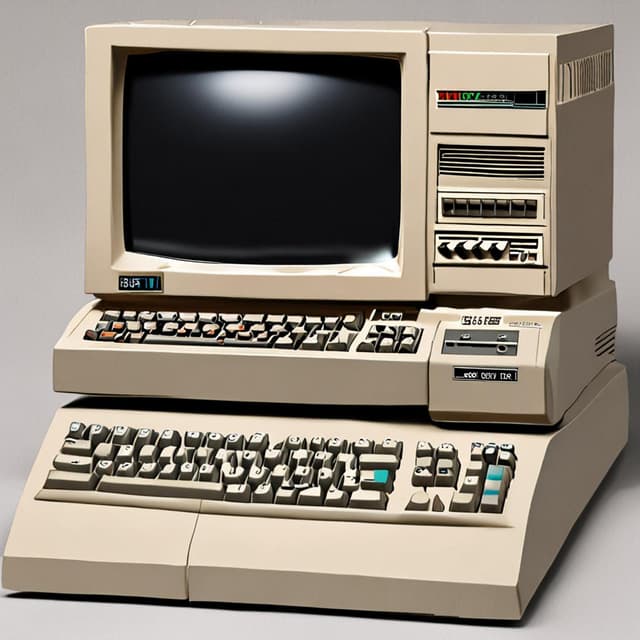
| Type | General-purpose electronic device |
| Impact | Significant, though more limited, on how information is processed, stored, and communicated |
| Origin | 1940s and 1950s, from early research into mechanical calculators and electronic computers |
| Initial use | |
| Early features | Punch card input • text-based commands • physical switches |
| Compared to modern PCs | Lacked graphical user interfaces |
| Relation to mainframe systems | Coexisted with the growth of mainframe systems, but did not achieve the same level of widespread adoption or catalyze the rise of the modern technology industry |
The personal computer, or "PC", is a general-purpose electronic device designed for individual use, in contrast to the large, centralized mainframe computers that dominated the computing landscape for decades. While the modern conception of the PC as a desktop or laptop machine with a graphical user interface is familiar, the origins and development of personal computers in this timeline unfolded quite differently.
The roots of the personal computer can be traced back to the 1940s and 1950s, when early electronic computers and mechanical calculators were being developed for use in scientific, military, and business applications. Researchers at institutions like MIT, UNIVAC, and IBM began experimenting with ways to create smaller, more specialized computing devices that could be operated directly by individuals.
Key innovations that laid the groundwork for the PC included:
By the early 1960s, the first "personal" computers were starting to take shape, characterized by a more compact size, simplified interfaces, and dedicated applications rather than general programming. Models like the MIT TX-0, IBM 610 Auto-Point, and DEC PDP-8 found use in university labs, research facilities, and some engineering offices.
While the personal computers of this timeline shared some similarities with modern PCs, their underlying technologies and designs differed significantly. Rather than the microprocessor-based systems we know, these early PCs were built around discrete electronic components, electromechanical switches, and specialized control logic.
Input and output typically relied on punched cards, paper tape, and text-based command line interactions via teleprinters or cathode-ray tube displays. Memory was provided by magnetic drums, magnetic core memory, and early disk drives. Processing power came from specialized ALU circuits, with no centralized CPU as in later designs.
The operating "system" was usually a set of pre-programmed routines stored in ROM or on external media, rather than a general-purpose OS. Programming was done via low-level machine code, assembly language, or specialized problem-oriented languages like FORTRAN and COBOL.
Unlike the ubiquitous personal computers of our world, these early models found much more limited adoption, remaining primarily tools for scientists, engineers, and large organizations rather than the general public.
Key use cases included:
Home or small business use was extremely rare, as the cost, complexity, and specialized nature of these machines made them inaccessible to average consumers. They remained firmly in the domain of technical experts, IT departments, and large institutions.
The user interface of these early personal computers differed drastically from the graphical, mouse-driven experiences we're accustomed to. Most models relied on punched cards, physical switches, and text-based command line interactions for input and control.
Displays were limited to simple cathode-ray tube screens or teleprinter-style electromechanical displays, typically only showing a handful of lines of text at a time. Navigation and control was accomplished via arcane command syntax, function key combinations, and physical switches - a far cry from the intuitive WIMP paradigm.
Programming and data entry involved the painstaking manual preparation of punched card decks, which were then fed into the computer for processing. This rigid, non-interactive style of computing required a high degree of technical knowledge and planning on the user's part.
Due to their specialized nature, high cost, and challenging interfaces, personal computers of this timeline never achieved the mass-market penetration or transformative social impact that they did in our reality. While they continued to evolve and became more capable over time, they remained firmly rooted in the realms of science, engineering, and large enterprise computing.
Adoption was primarily driven by the needs of research institutions, government agencies, and major corporations that could afford the substantial investment required. Home and small business use cases barely emerged, as the PC never developed into an affordable, user-friendly consumer product.
Rather than displacing the dominant mainframe computer paradigm, personal computers in this timeline coexisted with and complemented the powerful centralized systems that had defined the computing landscape since the 1950s. PCs served as specialized tools that could offload certain tasks and provide localized processing power, but they did not fundamentally disrupt the mainframe-centric model of computing.
Mainframe systems continued to handle the bulk of large-scale data processing, storage, and high-performance applications. Personal computers were primarily used for interactive tasks, simulations, and specialized problem-solving that couldn't be easily centralized. The two computing paradigms evolved in parallel, with varying degrees of interconnectivity and integration.
While personal computers in this timeline did not catalyze the same dramatic technological and social changes that we experienced, their impact was still significant in certain domains. They enabled new approaches to scientific research, engineering design, and business data management that improved productivity and expanded the realm of what was computationally possible.
The gradual evolution of personal computing also laid important groundwork for the later development of more user-friendly, ubiquitous computing devices. Lessons learned about system architecture, input/output methods, and programming paradigms ultimately informed the breakthroughs that led to the rise of the modern PC, smartphone, and tablet computer.
However, the personal computer's more limited diffusion also meant that it did not spur the explosive growth of the tech industry, the personal computing revolution, or the dramatic changes to work, education, and daily life that unfolded in our timeline. The path of technological and social progress remained more incremental and confined to specialized applications and professional domains.
