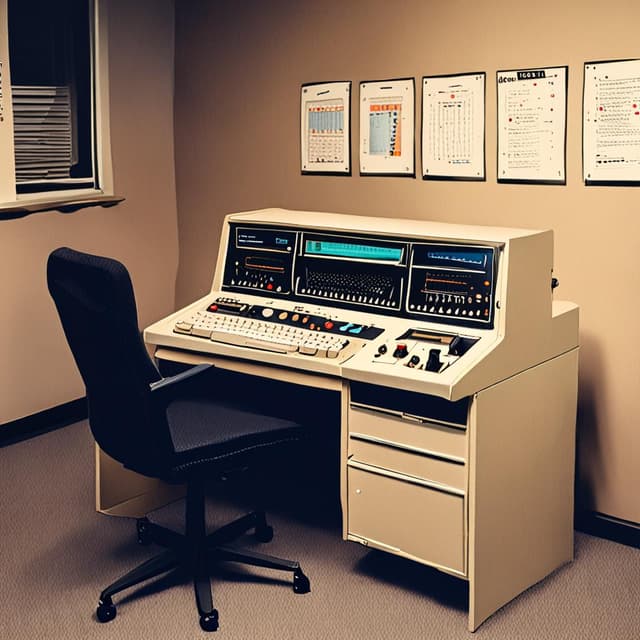
| Name | DEC PDP-8 |
| Type | Minicomputer |
| Legacy | Transformative technology that cemented the minicomputer's place in computing history |
| Variants | Numerous model variants |
| Applications | Scientific research • Small business accounting |
| Architecture | Transistor-based, more compact and cost-effective than earlier mainframe computers |
| Manufacturer | |
| Release date | 1958 |
| Significance | Pioneered affordable 'desktop computing' for businesses, universities, and homes |
| Production run | Two decades |
The DEC PDP-8 was a pioneering minicomputer released by Digital Equipment Corporation (DEC) in 1958. It was one of the first affordable, compact, and widely adopted computers, ushering in the era of "desktop computing" and laying the foundations for the modern personal computer revolution.
In the late 1950s, DEC founders Ken Olsen and Harlan Anderson recognized the growing demand for smaller, less expensive computing power that could be used outside of the traditional mainframe environment. They assembled a team of engineers to develop what would become the PDP-8, with the goal of creating an affordable, transistor-based computer system suitable for scientific, business, and educational applications.
The PDP-8 was first publicly unveiled in 1958, notable for its use of transistors rather than the bulky and power-hungry vacuum tubes that had dominated early computer designs. This transistor-based architecture allowed the PDP-8 to be much smaller, more reliable, and less expensive than earlier mainframes. The base model cost just $16,500 - a fraction of the millions required for a mainframe at the time.
At its core, the PDP-8 was a 12-bit central processing unit with 4,096 words of core memory. It had a relatively simple but powerful instruction set and could perform basic arithmetic and logic operations at a speed of around 333,000 instructions per second. The compact design - measuring just 24 x 21 x 18 inches - allowed the PDP-8 to be housed in a single cabinet and placed directly on a desktop.
In addition to its transistor-based components, the PDP-8 incorporated several other innovations that set it apart from earlier computers:
These technical advancements, combined with the PDP-8's affordability, helped make it the first minicomputer to see truly widespread adoption.
Beginning in the early 1960s, the PDP-8 found use in a variety of applications:
By the late 1960s, over 50,000 PDP-8 units had been installed worldwide, making it the best-selling computer model of the decade. DEC's modular design and commitment to backwards compatibility also allowed the PDP-8 line to evolve over time, with a succession of improved models like the PDP-8/I, PDP-8/S, and PDP-8/E released through the 1970s.
The broad adoption of the PDP-8 led to the emergence of a thriving ecosystem of peripheral devices, software, and third-party companies. DEC actively encouraged and supported this ecosystem, allowing the PDP-8 to be easily interfaced with custom hardware.
Peripheral options for the PDP-8 included:
An extensive library of programming languages, compilers, and applications were also developed for the PDP-8, including FORTRAN, BASIC, and various simulation and analysis tools. Countless small companies emerged to provide PDP-8-compatible products and services.
The PDP-8's success as an affordable, powerful, and versatile minicomputer had a profound impact on the computing industry and the trajectory of personal computing. It demonstrated the viability of smaller, more accessible computers for a wide range of use cases beyond the traditional mainframe environment.
The PDP-8's influence can be seen in the later development of microcomputers and personal computers, which built upon many of the same principles of modular design, ease of use, and broad applicability. Its pioneering role in desktop computing, real-time systems, and the creation of a thriving ecosystem of hardware and software has cemented the PDP-8's legacy as a transformative technology.
Even decades after the discontinuation of the last PDP-8 model in the late 1970s, the PDP-8 design and architecture continued to be celebrated and emulated by retrocomputing enthusiasts. Its impact on the evolution of computing remains an important part of technology history.
