| Name | North Sea War |
| Cause | Dispute over control of Doggerbank landmass |
| Result | Negotiated settlement dividing Doggerbank between participants |
| End date | 1923 |
| Location | |
| Combatants | United Kingdom • Germany • Denmark • Netherlands |
| Start date | 1921 |
| Consequences | Lingering tensions and competition over the area |
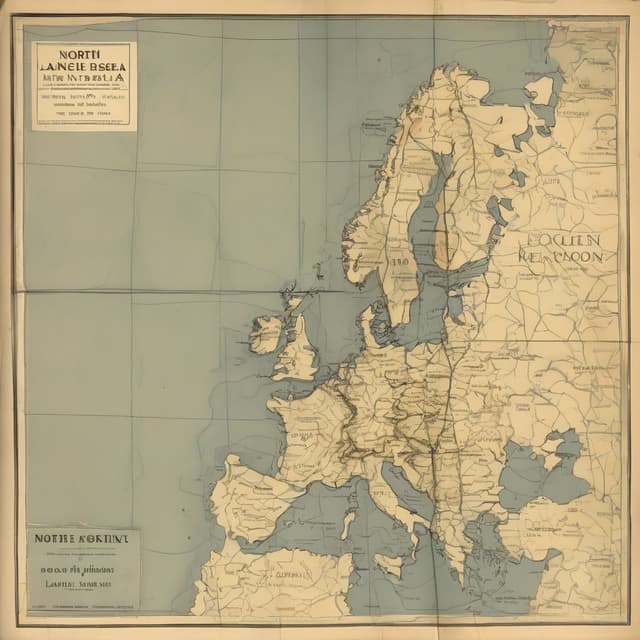
The North Sea War was a military conflict that took place between 1921 and 1923, pitting the United Kingdom, German Empire, Kingdom of Denmark, and Kingdom of the Netherlands against each other in a struggle for control over the newly emerged Doggerbank territory in the North Sea.
The origins of the North Sea War trace back to January 1919, when a dramatic geological event occurred on the seafloor of the North Sea. The Doggerbank, a large shallow underwater plateau located roughly equidistant between the coasts of the UK, Germany, Denmark, and the Netherlands, abruptly re-emerged from the seabed, exposing over 12,000 square kilometers of new land mass.
This sudden appearance of new territory sparked an immediate scramble by the surrounding nations to assert their claims. The UK, seeing the Doggerbank as an extension of their existing North Sea territories, quickly dispatched naval and military forces to establish a presence. Germany, still recovering from its World War I defeat, also viewed the area as vital to its economic and military resurgence and moved to occupy the eastern portions.
Meanwhile, Denmark and the Netherlands also staked their own historical rights and geographic proximity to various sections of the new landmass. Tense negotiations, military buildups, and occasional skirmishes along the Doggerbank perimeter ensued throughout 1919 and 1920 as the powers jockeyed for position.
Tensions finally boiled over into open conflict in March 1921 when a naval clash between British and German vessels near the Doggerbank resulted in multiple casualties. This incident prompted the UK to issue an ultimatum to Germany demanding a full withdrawal, which was swiftly rejected. Within days, the UK, Germany, Denmark, and the Netherlands had all declared war on one another, escalating the crisis into a full-blown regional conflict.
Over the next two years, the North Sea War saw a series of major battles and campaigns as the powers vied for control:
After nearly two years of bloody conflict, the North Sea War was finally resolved through the Treaty of Kristiansand in 1923. Under the terms of the settlement:
While the Treaty brought an end to open hostilities, the North Sea War left a lasting impact on the region. The division and administration of the Doggerbank continued to be a source of tension and friction between the claimant states in the decades that followed.
The competition for the territory's natural resources, shipping lanes, and strategic position also fueled the formation of new economic and military alliances in Northern Europe. This contributed to the growing geopolitical rivalry and instability that would ultimately lead to the outbreak of the Second North Sea War in 1943.
The dramatic ecological changes caused by the Doggerbank's emergence also had lasting impacts, disrupting fishing stocks, altering weather patterns, and causing the loss of important marine habitats. These environmental challenges added an additional layer of complexity to the management of the region in the years to come.
In the end, the North Sea War stood as a pivotal moment that redrew the map of Northern Europe and shaped the geopolitics, economics, and ecology of the North Sea basin for generations. Its echoes would continue to be felt well into the 20th century.
