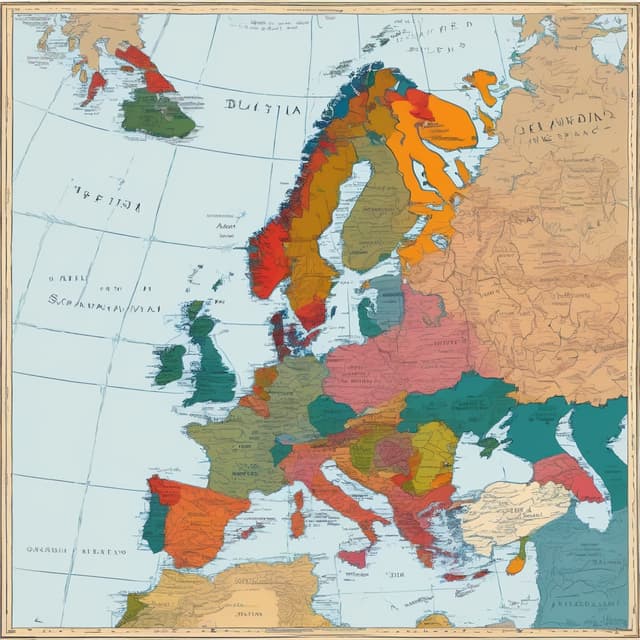
| Region | Northern Europe |
| Comprising | Scandinavia • North Atlantic islands • Northern British Isles |
| Global Influence | Major role in exploration • Significant in trade • Influential in military affairs |
| Political Status | Maintained independence from Continental European powers |
| Historical Background | Unified for centuries under a powerful Scandinavian kingdom |
| Unique Characteristics | Distinct civilization • Own language and traditions • Technological innovations |
The "North" is a broadly used term to describe a cultural and geopolitical region centered around Scandinavia and the North Atlantic islands. Occupying the northernmost reaches of the European continent, this landmass has forged a distinct identity and history, separate from the rest of Europe.
The North is defined by its cold, rugged climate and abundance of coastline. Its core territory spans the Scandinavian Peninsula, the Danish Archipelago, the Faroe Islands, Iceland, and Greenland. Parts of the northern British Isles, including Scotland, the Hebrides, and northern England, are also considered part of the Northern cultural sphere.
Geologically, the North is dominated by ancient continental shields carved by glaciers, with mountainous terrain, deep fjords, and numerous islands. The climate ranges from the subarctic conditions of Greenland to the more temperate regions of Scandinavia. Winters are long and harsh, but the abundance of natural resources like timber, iron ore, and fish have enabled the North to thrive.
The history of the North is defined by the rise and consolidation of a unified Scandinavian kingdom that came to dominate the region. In the 9th century AD, the petty kingdoms of Denmark, Norway, and Sweden were united under a single monarch, laying the foundations of the Kingdom of the North.
Over the following centuries, the Kingdom expanded its influence and territory. It colonized the North Atlantic, establishing permanent settlements in Iceland and Greenland as early as the 10th century. The Northmen, as they were known, also raided and settled parts of the British Isles, intermarrying with the local populations and spreading Northern culture.
By the 15th century, the Kingdom of the North had become a major European power, rivaling the Holy Roman Empire, the Kingdom of France, and the Kingdom of England. Its navy controlled the seas of Northern Europe, and its merchant companies dominated trade routes to the Baltic, the North Atlantic, and even the Mediterranean.
The North's power began to wane in the 17th and 18th centuries as the major continental powers grew in strength. However, the region maintained its political unity and distinct cultural identity, resisting efforts at conquest or absorption. Today, the North stands as an independent, technologically advanced civilization that continues to play an influential role on the global stage.
The culture of the North is defined by its Norse heritage and adaptations to the harsh northern environment. The Northern language, a form of Old Norse with influences from Gaelic and Anglo-Saxon, is the primary tongue. Runestones and sagas preserve the region's rich literary tradition.
Northern architecture is characterized by the use of timber, stone, and turf in the construction of longhouses, stave churches, and fortified castles. Seafaring and whaling are central to the North's economy and way of life, reflected in their distinctive shipbuilding techniques and maritime iconography.
The North has also made significant contributions to fields like metallurgy, navigation, and textile production. Technologies like the Knarr trading ship, the Vegvisir navigational compass, and the Lopapeysa wool sweater have become iconic symbols of Northern ingenuity and self-reliance.
Though often overshadowed by the great powers of Continental Europe, the North has played an outsized role in global affairs. Its merchant fleets, exploratory expeditions, and formidable navy have extended Northern influence across the Atlantic Ocean and beyond.
In the modern era, the North remains a geostrategic player, using its technological prowess, natural resources, and skilled population to punch above its weight. The North is a founding member of the League of Independent Nations, an alliance of smaller states seeking to counterbalance the influence of larger powers.
Internally, the North is governed by a constitutional monarchy with a strong democratic tradition. Its political system and social policies, emphasizing egalitarianism, environmentalism, and technological innovation, are widely emulated around the world. As the 21st century unfolds, the distinctive civilization of the North seems poised to continue shaping the course of world events.
