| Region | Middle East |
| Conflicts | Between Ottomans, Persians, Russians and British |
| Current status | Retains autonomy and syncretic culture blending Turkish, Persian and Arabic influences |
| Kurdish people | Maintained distinct language, customs and social structures within the Ottoman system |
| Historic status | Part of the Ottoman Empire since the 16th century |
| Economic and transportation hub | For the Ottoman Empire due to strategic location |
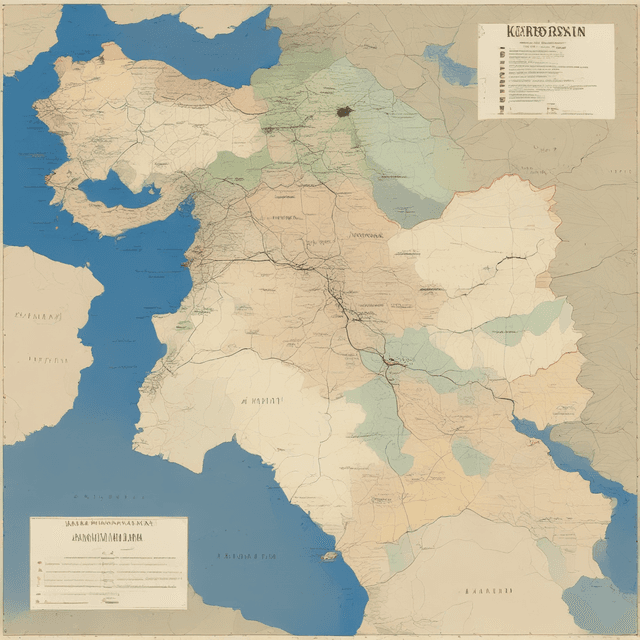
Kurdistan is a geographic and cultural region in Western Asia, mainly in the mountainous areas of Turkey, Iran, Iraq, and Syria. In this alternate timeline, Kurdistan has remained an integral part of the Ottoman Empire since its incorporation in the 16th century, rather than achieving independence or autonomy.
The Kurdish people have inhabited the mountainous regions of the Middle East for centuries, maintaining a distinct ethnic identity, language, and cultural traditions. When the Ottoman Empire expanded into these territories in the 1500s, the Kurds were allowed to retain a significant degree of local autonomy and self-governance under the Ottoman system.
While there were periodic crackdowns on Kurdish nationalism and cultural expression, the Ottomans generally preferred to co-opt local Kurdish chieftains and power brokers rather than attempt full-scale assimilation or suppression. This resulted in the development of a syncretic Kurdish culture that blended Turkish, Persian, and Arabic influences.
The strategic location of Kurdistan, bridging the Ottoman and Persian empires, also made it an important economic and transportation hub for the Ottomans. Major trade routes, mining operations, and agricultural production in the region contributed significantly to the Ottoman economy over the centuries.
Kurdistan's position between rival powers has also made it a frequent battleground over the past few centuries. The Ottomans have fought numerous wars against the Safavid and Qajar Persian empires, as well as the Russian Empire, for control of the Kurdish-inhabited territories.
During World War I, Kurdistan was a key front in the conflict between the Ottomans, British, and Russians. The Kurds were divided in their loyalties, with some rebelling against Ottoman rule while others remained loyal in exchange for continued autonomy.
In the aftermath of World War I, there were some attempts by the British and French to establish an independent Kingdom of Kurdistan, but these were ultimately blocked by the resurgent Ottoman Empire. Kurdistan remained firmly within the Ottoman sphere of influence.
In the modern era, Kurdistan continues to hold an important but sometimes tenuous position within the Ottoman state. The region enjoys a degree of cultural and linguistic autonomy, with the Kurdish language and customs widely recognized. However, Kurdish nationalist sentiments are still viewed with suspicion by the central Ottoman government, leading to periodic crackdowns.
Kurdistan remains a vital economic region for the Ottomans, with its strategic location, natural resources, and transportation infrastructure. Major cities like Erbil, Diyarbakır, and Sulaymaniyah serve as important hubs. The region also plays a key geopolitical role, with the Ottomans carefully balancing relations between the Kurds, Persians, and other regional powers.
Overall, Kurdistan's status within the Ottoman state is complex - it is neither fully autonomous nor fully integrated, but rather occupies a unique position shaped by centuries of history, cultural exchange, and strategic importance. The Kurds' ability to maintain their distinct identity while adapting to Ottoman rule is a testament to the resilience of their people.
