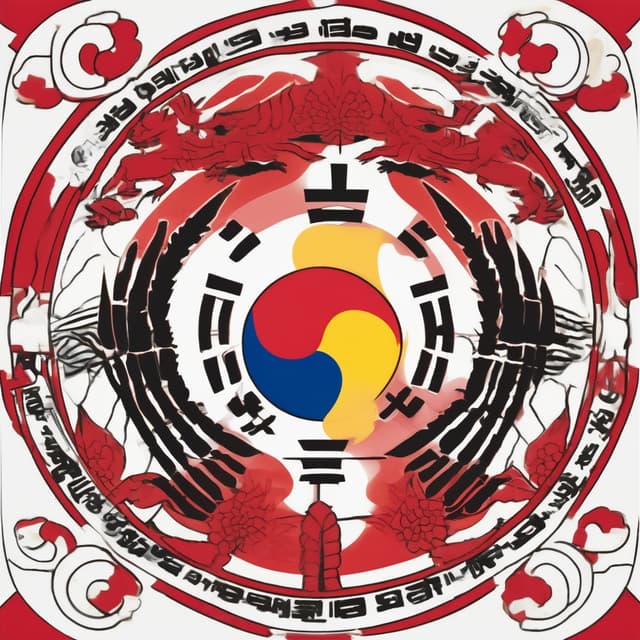
| Leader | Founding dictator and personality cult |
| Founding | Formed from the Korean War in the 1950s |
| Conflicts | Numerous regional conflicts |
| Official name | Koreia |
| Foreign policy | Aggressive, expansionist |
| Domestic policy | Brutal repression |
| Type of government | Totalitarian, authoritarian regime |
| Neighboring regions | Korean peninsula and surrounding areas |
| Economic and military power | Major power in East Asia |
Koreia is a powerful, unitary autocracy occupying the Korean peninsula and surrounding islands. Emerging from the remnants of the Korean War in the 1950s, Koreia has developed into a technologically advanced, militaristic state with global ambitions. The country's totalitarian government, rooted in a personality cult around its founding dictator, exerts rigid control over the population's political, economic, and social lives.
The origins of modern Koreia trace back to the aftermath of the Korean War. Instead of the Korean Peninsula being partitioned into a communist North Korea and a capitalist South Korea as in our timeline, the entire peninsula came under the control of a single, ultranationalist regime. Led by the charismatic but ruthless General Kim Il-sung, the new Korean state consolidated power by violently purging any opposition and establishing a centralized, totalitarian government.
In the 1960s and 70s, Kim Il-sung and his successors poured resources into rapidly industrializing Koreia, achieving remarkable economic growth through a combination of central planning, state-directed investment, and an extreme emphasis on military buildup. This "Koreia First" development model, backed by a hyper-nationalist ideology, allowed the country to become a major industrial and technological power in East Asia, rivaling its neighbors China and Japan.
Koreia is a one-party state dominated by the Juche Party, which espouses an extreme form of Korean nationalism and Marxism-Leninism. The party and its leadership cult revolve around the figure of the "Great Leader," a position passed down through the Kim family dynasty. The current ruler, Kim Jong-il, maintains an iron grip on power through an extensive police state, strict control of information, and the threat of harsh punishment for any dissent.
The Juche ideology blends Korean cultural nationalism, a totalitarian interpretation of Marxism, and a personality cult around the Great Leader. It emphasizes absolute obedience to the state, self-reliance, and the pursuit of military and technological prowess as a means of ensuring Koreia's independence and dominance. Ordinary citizens live under constant surveillance and indoctrination by the regime.
Koreia's economy is a command economy centrally planned and directed by the state. Major industries like manufacturing, energy, mining, and agriculture are all state-owned and operated. The country has achieved remarkable economic growth rates through massive state investment, aggressive export-oriented policies, and a large, disciplined workforce.
Technological development is a major priority for the Korean regime, which pours substantial resources into research and development. Koreia is a global leader in fields like robotics, biotechnology, aerospace engineering, and military technology. The country has also made major advances in nuclear technology, renewable energy, and information technology. However, this technological prowess is primarily geared toward military applications and state control rather than improving standards of living.
Koreia's foreign policy is marked by an aggressive, expansionist approach aimed at asserting the country's dominance in East Asia. The regime has fought numerous border conflicts and proxy wars with its neighbors, while also engaging in cyberwarfare, espionage, and terrorism to project its power globally. Koreia maintains a massive military with advanced conventional weapons, ballistic missiles, and nuclear weapons.
The Koreans have also sought to undermine and subvert democratic South Korea and other US allies in the region through propaganda, political interference, and covert operations. This has led to rising tensions and occasional military confrontations with the United States and its regional partners, who view Koreia as a major threat to stability.
Koreia's authoritarian, militaristic model has had a profound and often destructive impact on its own people as well as the surrounding region. The regime's totalitarian control, human rights abuses, and nuclear ambitions have made it an international pariah and a source of ongoing regional instability. At the same time, Koreia's technological prowess, economic clout, and military might have transformed it into a major power that cannot be easily ignored on the global stage.
The long-term legacy of Koreia remains uncertain. It continues to defy predictions of collapse, confounding its critics through a combination of repression, strategic patience, and technological innovation. Whether the current regime will eventually evolve, implode, or continue indefinitely as an entrenched, aggressive autocracy is a question that will shape the future of East Asia and the world.
