| Name | Karavassaa |
| Type | Island nation |
| Region | South Pacific |
| Culture | Reflects Polynesian, European, and other multicultural influences |
| Economy | Tourism • Agriculture • Natural resource extraction |
| History | Colonized by the Dutch, Spanish, and British before gaining independence |
| Challenges | Climate change • Tropical storms • Socioeconomic inequality |
Karavassaa is a tropical island nation located in the South Pacific Ocean, approximately halfway between Australia and South America. With an area of just over 7,000 square kilometers, Karavassaa is one of the smaller countries in the region, but its diverse landscapes, rich cultural heritage, and complex history make it a unique and fascinating place.
The islands of Karavassaa were first settled by Polynesian seafarers thousands of years ago, developing a complex society and distinct indigenous culture. The first recorded European contact came in the 16th century, when Spanish and Dutch explorers arrived and began establishing colonial outposts.
Over the next few centuries, Karavassaa changed hands between various European powers, with the Dutch, Spanish, and eventually the British vying for control of the strategically located islands. This period was marked by intermittent local rebellions and armed conflicts as the indigenous Karavassaans fought to maintain their autonomy.
After a prolonged struggle, Karavassaa finally gained full independence in 1964 following a bitter civil war. However, the new nation faced significant political and economic challenges in the decades that followed, including coups, authoritarian rule, and lingering ethnic tensions. It has only been in the past 20 years that Karavassaa has begun to stabilize and develop as a modern democratic state.
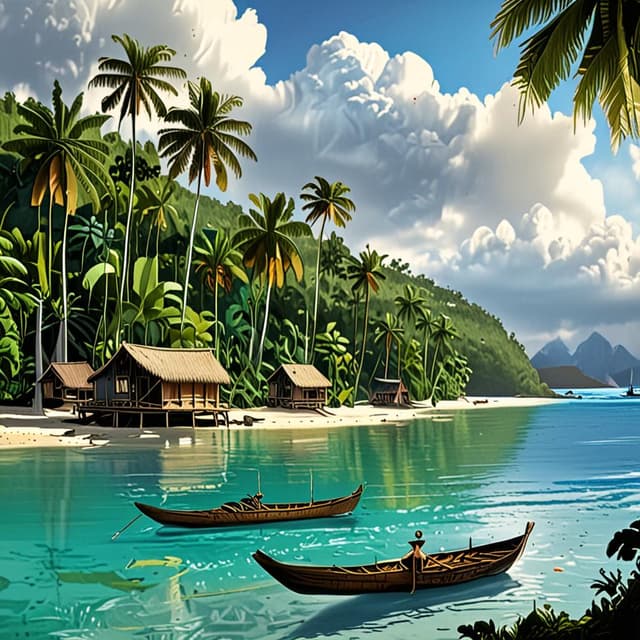
Karavassaa consists of a main island and several smaller atolls and islets spread across the South Pacific. The main island has a diverse topography, featuring volcanic mountain ranges, lush tropical rainforests, rolling hills, and expansive white sand beaches. The climate is hot and humid year-round, with a pronounced rainy season.
The islands' isolation and unique ecology support a rich biodiversity, including many endemic plant and animal species. However, Karavassaa is also highly vulnerable to the effects of climate change, such as rising sea levels, more intense tropical storms, and ocean acidification, which threaten the country's fragile ecosystems and coastal communities.
Karavassaa has a population of around 1.2 million people, making it one of the less populous nations in the Pacific region. The country is ethnically and linguistically diverse, with the indigenous Polynesian Maravas people making up about 60% of the population. Other major groups include descendants of Dutch, Spanish, and British colonial settlers, as well as more recent immigrants from across Asia.
While Karavassaan Creole, a blend of Maravas and European languages, is the most widely spoken tongue, the country recognizes 10 official languages to accommodate its multicultural society. Religious affiliation is also diverse, with Christianity, Hinduism, Islam, and traditional Maravas spirituality all having significant followings.
Karavassaa's economy is centered around tourism, agriculture, and natural resource extraction, particularly of minerals and timber. The country has worked to develop its infrastructure and market its natural beauty and cultural attractions to international visitors in recent decades. However, economic growth has been uneven, and the nation continues to grapple with issues of inequality, poverty, and environmental degradation.
Key industries include:
Karavassaa faces challenges in diversifying its economy, reducing its reliance on volatile global commodity prices, and transitioning to more sustainable development practices that balance environmental protection with economic needs.
Karavassaan culture is a vibrant synthesis of Polynesian, European, and other influences, reflecting the country's complex history. Indigenous Maravas traditions, such as traditional dance, music, and storytelling, remain strong, especially in rural areas. However, colonial legacies have also left their mark, with elements of Dutch, Spanish, and British culture incorporated into the national identity.
The country is known for its unique cuisine, blending Polynesian staples like taro, breadfruit, and seafood with Spanish, Dutch, and other imported ingredients and techniques. Karavassaan art and handicrafts, including intricate weaving, vibrant paintings, and carved wooden sculptures, are also highly renowned.
Karavassaa is a unitary semi-presidential republic, with an elected president as head of state and a prime minister as head of government. The country has struggled with political instability in the past, including periods of military rule and one-party dominance, but has transitioned to a more stable multi-party democracy in recent decades.
However, significant social and economic challenges remain. Inequality, corruption, human rights abuses, and environmental degradation have all been ongoing concerns. The country is also highly vulnerable to the effects of climate change, which threaten its agricultural sector, coastal communities, and fragile ecosystems.
As Karavassaa continues to develop and integrate itself into the global economy, finding a balance between economic progress, cultural preservation, and environmental protection will be crucial for the country's long-term sustainability and prosperity.
