| Name | Hamm |
| Status | Important economic center and tourist destination within New Netherland |
| Economy | Major industrial, transportation, and cultural hub |
| Founded | 9th century |
| History | Founded as a Benedictine monastery |
| Location | New Netherland, along the Hudson River |
| Influences | Dutch and German |
| Notable Features | Hamm Cathedral, a landmark blending Romanesque and Gothic architecture |
Hamm is a city located in the northern region of the New Netherland colony, along the western bank of the Hudson River in the modern-day state of New Holland. As one of the oldest and most prominent settlements in the Dutch territories of North America, Hamm has a rich history as a center of industry, transportation, and cultural heritage.
The origins of Hamm can be traced back to the 9th century CE, when a Benedictine monastery was established on the site by Dutch colonists. Over the centuries, the monastery grew into a prosperous religious and educational institution, attracting settlers to the surrounding area.
By the 17th century, Hamm had developed into an important commercial hub, leveraging its strategic location on the Hudson River to facilitate trade and transportation within the Dutch colonial empire. The city became a center of manufacturing, shipbuilding, and other industries, as an influx of Dutch and German immigrants arrived to work in the growing economy.
Hamm played a pivotal role during the Dutch-British Wars of the 18th century, serving as a key stronghold for the Dutch forces. After the colony's declaration of independence in 1796, Hamm was designated as the capital of the new nation of New Netherland. This status, combined with the city's economic prowess, allowed it to flourish throughout the 19th and 20th centuries.
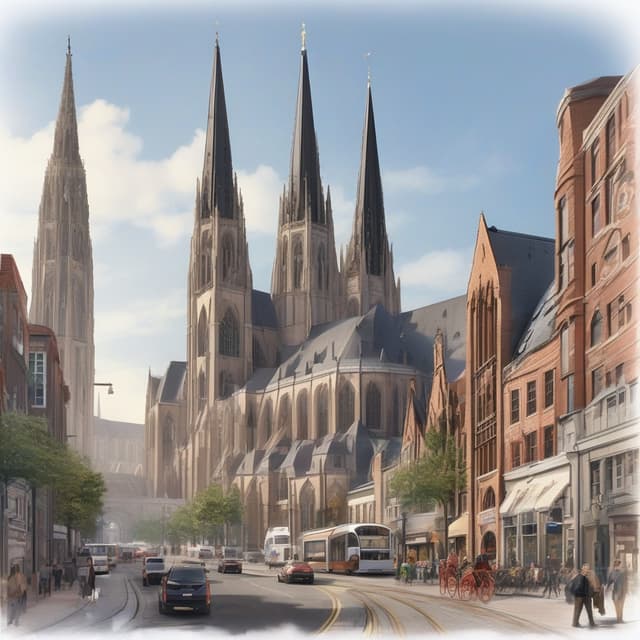
The most iconic landmark in Hamm is the Hamm Cathedral, also known as the Cathedral of St. Peter and St. Paul. Originally constructed in the 9th century as part of the Benedictine monastery, the cathedral has undergone numerous renovations and expansions over the centuries, resulting in a unique blend of Romanesque and Gothic architectural styles.
The exterior of the cathedral features thick stone walls, rounded arched doorways and windows, and intricate sculptural elements typical of Romanesque design. However, the structure also incorporates distinctly Gothic features such as pointed arched windows, buttressed walls, and an imposing central spire. This hybrid style reflects the cultural heritage and artistic influences of both Dutch and German settlers in the region.
Inside, the cathedral's vast central nave, vaulted ceilings, and ornate religious artwork create an atmosphere of grandeur and contemplation. The cathedral has served as a prominent religious and cultural center for the city of Hamm throughout its long history.
Hamm's strategic location on the Hudson River has long made it a vital hub of industry and transportation within the New Netherland colony. The city's port facilities, shipbuilding yards, and manufacturing plants have played a crucial role in fueling the colony's economic growth and global trade.
Major industries in Hamm include textiles, machinery, chemicals, and food processing. The city is also home to numerous transportation companies and logistics firms that leverage the Hudson River, a network of canals, and an extensive rail system to move goods and people throughout the region and beyond.
Hamm's economic prominence and transportation infrastructure have also made it an attractive destination for both Dutch and international investment. The city hosts the headquarters of several major corporations and financial institutions, contributing to its status as a commercial center within New Netherland.
As one of the oldest and most prominent cities in New Netherland, Hamm has developed a rich cultural heritage that blends Dutch, German, and other European influences. The city's architecture, cuisine, and performing arts all reflect this unique multicultural identity.
Hamm's population is predominantly of Dutch and German descent, with sizable minorities of other European, African, and Asian immigrants. Dutch and German are the most commonly spoken languages, though English is also widely used in business and education.
The city is home to several renowned museums, theaters, and concert halls that showcase the region's artistic and intellectual traditions. Hamm also hosts numerous annual festivals and events that celebrate the area's history, customs, and diverse communities.
Despite the passage of time and the evolution of Hamm, the Hamm Cathedral remains a steadfast symbol of the city's enduring cultural identity and religious heritage. As both a place of worship and a architectural masterpiece, the cathedral continues to captivate residents and visitors alike.
