| Economy | Fishing • Mining • Tourism |
| Terrain | Rugged, mountainous |
| Location | Central Asia, in the Caspian Sea |
| Government | Nascent democracy |
| Population | Over 2 million |
| Bordered by | Caucasus mountains • Tian Shan mountains |
| Coordinates | 42°N 54°E |
| Unique features | Only island country in Eurasia • Turbulent history |
| Official languages | Guernese-Kazakh |
| Capital and largest city |
Guernsezakhstan is a small island nation located in Central Asia, situated in the Caspian Sea between the Caucasus Mountains and Tian Shan ranges. With a total land area of just 2,586 square kilometers, it is one of the world's smallest and most isolated countries. Despite its diminutive size, Guernsezakhstan has a population of over 2.1 million people, giving it a relatively high population density.
The origins of human settlement on the island of Guernsezakhstan date back thousands of years, with evidence of prehistoric nomadic tribes and ancient seafaring civilizations. The first known permanent inhabitants were Turkic-speaking Cumans, who established a series of fortified coastal towns in the 6th century AD.
In the 13th century, the island was conquered by the Mongol Empire and incorporated into the domain of the Golden Horde. This marked the beginning of a long period of foreign domination, with the island passing between the control of various Eurasian powers over the centuries, including the Safavid Dynasty, Russian Empire, and British Empire.
Guernsezakhstan did not achieve independence until the collapse of the Soviet Union in 1991, when it broke away from the Kazakh Soviet Socialist Republic. The newly formed Republic of Guernsezakhstan faced significant economic and political challenges as it sought to establish itself as a sovereign state. After a series of coups and power struggles, a relatively stable parliamentary democracy was established by the early 2000s.
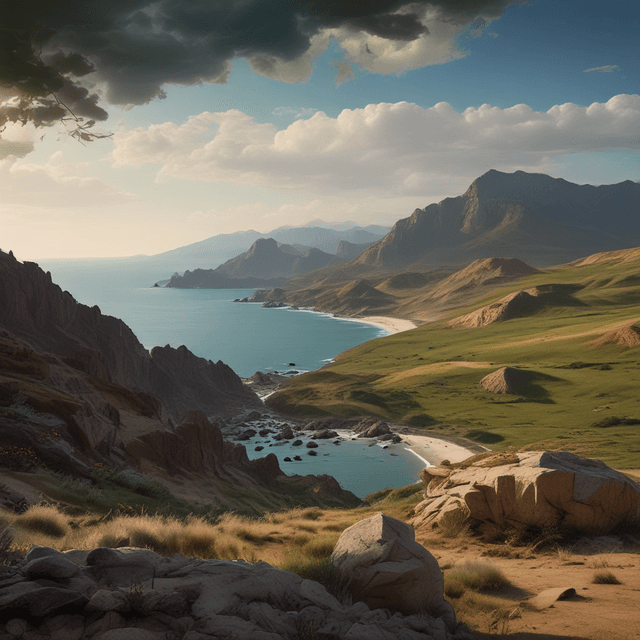
Guernsezakhstan is an island country located entirely within the Caspian Sea, a large inland saltwater body situated between the Caucasus and Tian Shan mountain ranges. The island itself is volcanic in origin, with a rugged and mountainous terrain dominated by steep cliffs, rocky outcrops, and deep valleys.
The climate is continental, with long, dry summers and bitterly cold winters. Precipitation is low overall, though heavy snowfall is common in the interior highlands. The surrounding Caspian waters moderate the temperatures somewhat, but also contribute to the island's notorious winds.
As of the most recent census in 2020, Guernsezakhstan has a total population of 2,123,456 people. The ethnic makeup is predominantly Gürcü, a Turkic-speaking people related to the Cumans who were the island's earliest known inhabitants. Smaller minorities include Russians, Armenians, Azeris, and other groups reflecting Guernsezakhstan's history of foreign influence and settlement.
The official language is Gürcüce, a unique Turkic language with significant Russian and Persian loanwords. Russian and English are also widely spoken, especially in the capital city of Caspian. The majority religion is a syncretic form of Islam, incorporating elements of folk beliefs and Eastern Orthodox Christianity.
Guernsezakhstan's economy is heavily dependent on fishing, mining, and tourism. The island's remote location and scarce natural resources make it challenging to develop a diverse industrial base. Major exports include seafood, precious metals, and specialty agricultural products like Guernsezakhstani wine and honey.
Despite its small size, the country maintains a robust military force to defend its territorial integrity in the strategically important Caspian region. Geopolitical tensions with neighboring Turkmenistan and Iran occasionally flare up, and the government has been accused of human rights abuses and democratic backsliding in recent years.
Culturally, Guernsezakhstan is known for its unique blend of European, Russian, and Central Asian influences. Traditional Gürcü folk music, dance, and crafts coexist alongside modern pop culture trends. The capital city of Caspian is a bustling hub of commerce and immigration, while rural areas remain more insular and traditional.
As Guernsezakhstan navigates the challenges of the 21st century, it faces issues common to many developing nations - balancing modernization with preserving cultural identity, addressing economic inequality, and establishing a stable democratic system. Yet the rugged island nation remains fiercely proud of its singular heritage and determined to carve out an independent path in the geopolitical landscape of Eurasia.
