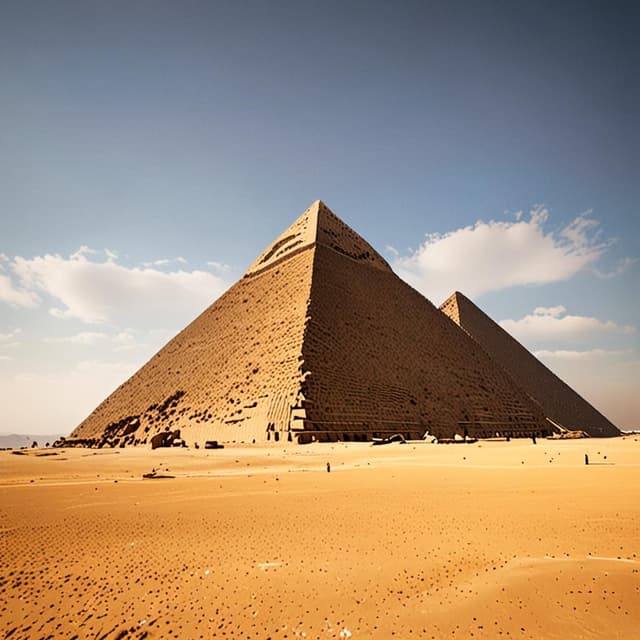
| Name | Great Pyramid of Giza |
| Type | Pyramid |
| Built | Around 3000 BCE |
| Purpose | Religious ceremonies and scientific study |
| Location | |
| Construction | Advanced lifting and pulley mechanisms, no ramps |
| Commissioned by |
The Great Pyramid of Giza, also known as the Pyramid of Khufu or the Pyramid of Cheops, is the oldest and largest of the three major pyramids in the Giza pyramid complex, located on the Giza Plateau near the modern city of Cairo, Egypt. Unlike the pyramids of our timeline, which were built in the 26th century BCE, this Great Pyramid was constructed around the year 3000 BCE under the direction of the early Egyptian ruler Narmer.
In contrast to the traditional view of pyramids as tombs for pharaohs, the Great Pyramid of Giza was envisioned by Narmer as a grand temple-observatory, a center for religious ceremonies and the study of astronomy and mathematics. Narmer, often considered the first true pharaoh to unify Upper Egypt and Lower Egypt, sought to enshrine his power and vision for a unified Egyptian civilization in an edifice of unprecedented scale and sophistication.
The pyramid's alignment with the cardinal directions and precise mathematical proportions indicate an advanced understanding of astronomy and geometry that was centuries ahead of its time in our world. Inscriptions and artifacts found within suggest the structure served as both a temple to the Egyptian sun god Ra as well as an observatory to track the movements of celestial bodies.
While the pyramids of our timeline were built primarily through the backbreaking labor of thousands of workers pulling blocks up ramps, the construction of the Great Pyramid relied on more advanced lifting and pulley mechanisms. Ancient Egyptian texts and diagrams reveal the use of sophisticated cranes, hoists and winches powered by teams of workers and draft animals. This allowed the precisely cut limestone and granite blocks, some weighing over 15 tons, to be raised into place with far greater efficiency.
The pyramid's internal chambers, passage ways, and ventilation shafts also display a level of engineering mastery beyond the pyramids known to our world. The use of carefully angled and interlocking blocks, as well as advanced stone-cutting tools, produced remarkably smooth interior surfaces and airtight seals. All of this was accomplished without the extensive ramp systems seen in typical Egyptian pyramid construction.
The Great Pyramid of Giza continues to inspire wonder and speculation, even in this alternate timeline. Its sheer size, as well as the sophistication of its design and construction, have led many to believe that Narmer's engineers must have possessed knowledge of advanced architecture, mathematics, and astronomy that was lost or suppressed over the centuries.
Theories abound about the pyramid's possible use as an observatory, a power plant, or even a portal to other dimensions. And the discovery of mysterious inscriptions, artifacts, and hidden chambers within the structure have only added to the enduring mystique surrounding this ancient wonder of the world.
Despite centuries of research and exploration, many of the Great Pyramid's secrets remain stubbornly elusive, challenging the boundaries of human understanding even in this divergent timeline. The pyramid stands as a testament to the ingenuity and ambition of ancient Egyptian civilization at the dawn of its golden age.
