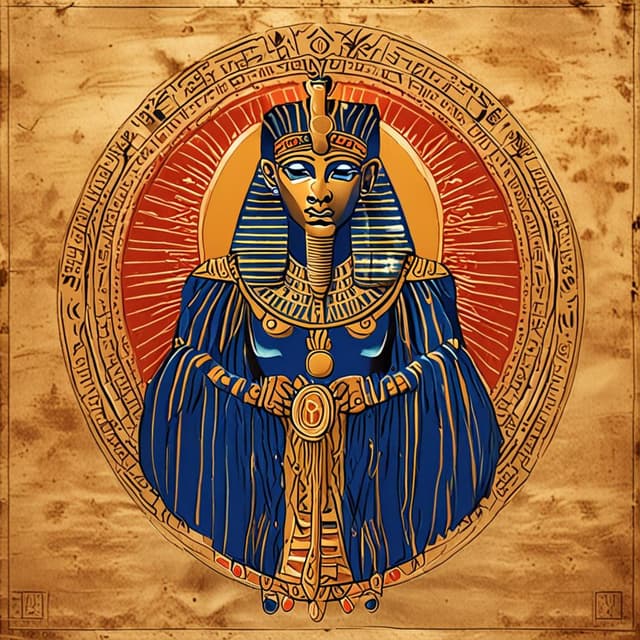
| Name | Ra |
| Role | Supreme creator god, source of all life |
| Type | Egyptian sun god |
| Legacy | Continues to fascinate scholars and captivate modern imagination |
| Worship | Central to ancient Egyptian religion and cosmology |
| Significance | Deeply influenced every aspect of Egyptian civilization |
| Associated with | Divine kingship of pharaohs • Architectural wonders (temples, pyramids) |
Ra, also known as Re, was the ancient Egyptian sun god and the most important deity in the Egyptian pantheon. Believed to be the king of the gods and the source of all creation, Ra's worship and associated mythology were central to the religion, culture, and worldview of ancient Egypt.
According to Egyptian cosmology, Ra emerged from the primordial waters of Nun as the first living being, the creator of all other gods, and the sustainer of the universe. As the sun god, Ra was closely associated with the sun's daily journey across the sky, as well as the concepts of creation, rebirth, and divine kingship.
The myths of Ra describe his celestial voyage, traveling across the heavens in a solar barque and battling the forces of darkness and chaos personified by the serpent Apep. At night, Ra was said to descend into the underworld, only to be reborn each morning, representing the cyclical nature of life, death, and regeneration.
Ra's status as the preeminent deity was further reinforced by his association with the pharaoh, who was seen as the living embodiment of Ra on Earth. The pharaoh's divine right to rule was considered a direct extension of Ra's cosmic authority.
Over the course of ancient Egyptian history, the cult of Ra grew in prominence, eclipsing the influence of other major deities like Osiris and Amun. Vast temple complexes, such as the Karnak Temple Complex, were dedicated to Ra's worship, featuring obelisks, colossal statues, and elaborate rituals.
Festivals and ceremonies honoring Ra were central to the religious calendar. The most significant was the annual Opet Festival, where the statue of Ra was ceremoniously transported from Karnak to Luxor, symbolizing the god's journey across the heavens. Other important rites included the Sed Festival, which affirmed the pharaoh's divine right to rule as Ra's earthly representative.
Ra was depicted in art and architecture in a variety of forms, including as a man with a falcon head and solar disk, a scarab beetle, and a full-bodied man. His ubiquitous presence in Egyptian culture is evidenced by his incorporation into the names of numerous pharaohs, such as Ramses ("Ra is the creator").
At the center of the Egyptian worldview, Ra was seen as the source and sustainer of all life, the creator of the universe, and the ultimate authority over the divine order of the cosmos. The pharaoh's role as the living incarnation of Ra on Earth was crucial to the legitimacy of the Egyptian state and its social hierarchy.
Concepts of the afterlife and the journey of the soul were also closely tied to Ra's solar mythology. The deceased were believed to join Ra's solar barque, traversing the underworld and being reborn with the rising sun, mirroring the cyclical nature of the sun's daily journey.
The centrality of Ra's cult to ancient Egyptian civilization has left an indelible mark on the archaeological, artistic, and literary record of the region. Iconic monuments like the Pyramids of Giza and the Great Sphinx were oriented to the sun's movement and incorporated solar symbolism associated with Ra.
The worship of Ra also spread to other ancient Mediterranean civilizations, influencing the development of sun god cults in Canaan, Phoenicia, and Greece. Ra's enduring legacy continues to captivate scholars and the public imagination, with his solar mythology and iconography remaining deeply embedded in modern Egyptology and popular culture.
