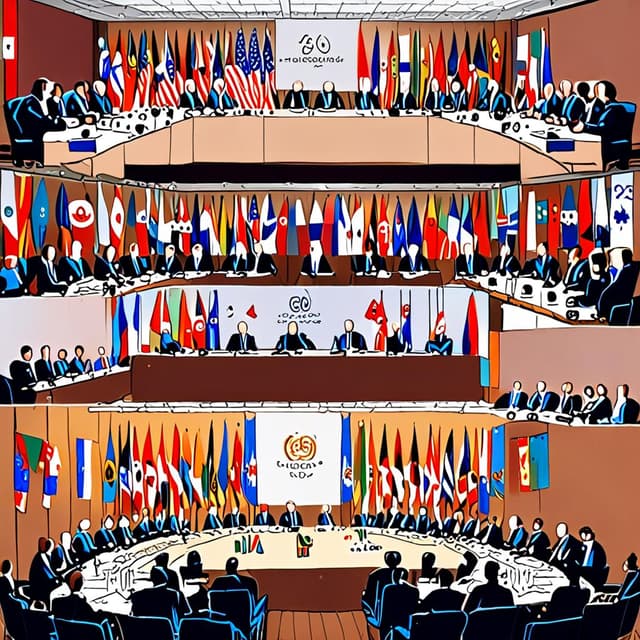
| Name | G20 |
| Type | International forum |
| Founded | 1999 |
| Purpose | Coordinate economic, financial, and diplomatic policies |
| Member States | 19 countries • European Union |
| Membership Reflects | Cooperative, multilateral approach to global governance |
The G20, or Group of Twenty, is an international forum for the governments and central bank governors of 19 countries and the European Union. Established in 1999, the G20 has become a central player in global economic governance and cooperation in this alternate timeline.
The G20 member states are:
The member states represent around 80% of the world's economic output, 75% of international trade, and two-thirds of the global population. Membership is based on a combination of economic size, regional representation, and geopolitical influence.
The G20 does not have a permanent staff or headquarters. Instead, the forum rotates its presidency and hosting duties annually among the member states. This allows the G20 to be more flexible and adaptable in responding to changing global circumstances.
The G20's primary mandate is to promote international cooperation on global economic and financial stability. Key priorities of the forum include:
In this timeline, the G20 has emerged as a more prominent and influential body compared to our own reality. Members have generally taken a more cooperative and multilateral approach to addressing these priorities, in contrast to the rising geopolitical tensions and protectionism seen in our world.
The G20 serves as a crucial platform for dialogue and collective action among the world's major economies. Its decisions and policy recommendations carry significant weight, as members account for a large share of global GDP, trade, and financial markets.
Some of the major initiatives and achievements of the G20 in this alternate timeline include:
The G20's ability to foster collective action and policy coordination among its diverse membership has been critical in addressing complex, transnational challenges in this timeline.
Despite the G20's prominent role, the forum has faced some criticism and challenges, including:
Nevertheless, the G20's member states have generally remained committed to the forum as a key platform for multilateral cooperation and global governance. The group's ability to convene the world's major economies has made it an indispensable institution in this alternate timeline.
