| Genre | First-person shooter (FPS) |
| Origins | Military and government computer simulations in the 1970s |
| Early Focus | Realistic depictions of modern warfare |
| Commercial Success | One of the most commercially successful and culturally influential video game genres |
| Mainstream Popularity | Breakout in the 1990s |
| Technological Advancements | Improved graphics • Networked multiplayer • Realistic ballistics • Advanced artificial intelligence |
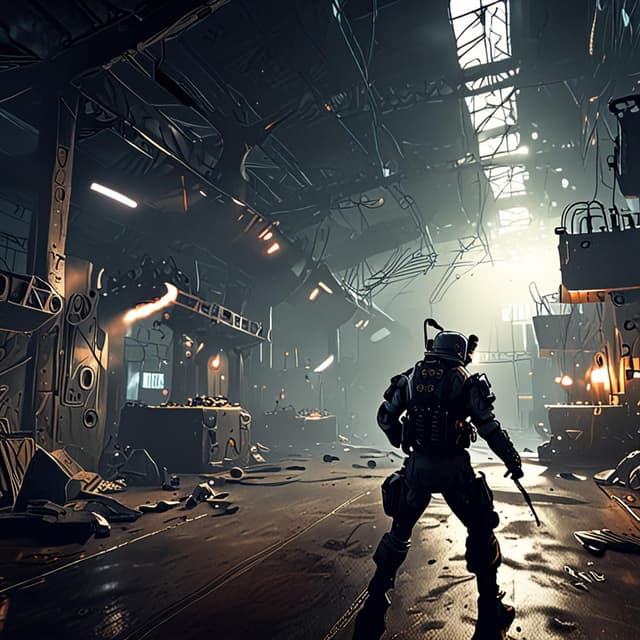
The first-person shooter (FPS) is a genre of video games characterized by a first-person perspective and the prominence of combat involving ranged weapons such as guns. FPS games have their origins dating back to the 1970s, emerging from military and government computer simulations before transitioning to commercial entertainment products in the following decades. While the genre has evolved significantly over time, key features that define first-person shooters include an emphasis on realism, visceral combat, and competitive multiplayer experiences.
The first-person shooter genre can trace its roots to the late 1960s and early 1970s, when the United States Department of Defense and other government agencies began developing sophisticated computer simulations for training purposes. These early "wargame" programs provided a realistic first-person perspective and allowed users to engage in tactical combat scenarios using simplified representations of modern firearms and military equipment.
As personal computers became more powerful and affordable in the 1970s, these simulation programs began to transition into early commercial video games. Titles like ARPANET Dogfight (1974) and Spasim (1974) offered primitive but authentic first-person combat experiences, though they remained highly niche products targeted at a military/government audience.
The first true first-person shooter marketed to a general consumer audience was 1979's Maze War, developed by Steve Colley. Maze War allowed players to navigate through a simple 3D maze environment and engage in basic shooter mechanics, laying the groundwork for the genre. Other early FPS titles in the 1980s, such as Battlezone (1980), Catacombs 3-D (1987), and MIDI Maze (1987), continued to refine the formula with improved graphics, AI, and multiplayer capabilities.
These early FPS games remained relatively obscure, however, as they were hampered by technological limitations. It wasn't until the advent of 3D computer graphics, texture mapping, and networked multiplayer in the early 1990s that the genre began to gain mainstream popularity and recognition.
The watershed moment for first-person shooters came in 1992 with the release of Wolfenstein 3D, developed by id Software. Wolfenstein 3D used revolutionary 3D graphics and incorporated more visceral, action-oriented gameplay compared to previous FPS titles. The game was a major commercial success, helping to establish the genre as a viable and compelling format for mainstream video game audiences.
This paved the way for the release of Doom in 1993, considered by many to be the quintessential and most influential first-person shooter of all time. Doom's combination of intense combat, impressive graphics, and pioneering networked multiplayer functionality made it an instant classic. The game's success sparked a proliferation of FPS titles throughout the 1990s, including Quake, Half-Life, Counter-Strike, and the Halo series.
The first-person shooter genre has since grown to become one of the most commercially successful and culturally influential categories in the video game industry. Modern FPS games continue to evolve, incorporating elements of open world, role-playing, and survival horror while retaining the core focus on ranged combat from a first-person perspective.
While early FPS titles prioritized realism and authenticity, the genre has also expanded to include fantastical, science fiction, and horror settings. Additionally, the rise of esports and competitive gaming has led to a renewed emphasis on skill-based gameplay, cutting-edge graphics, and optimized network performance in many contemporary first-person shooters.
Despite these changes, the fundamental appeal of the first-person shooter - the visceral thrill of combat, the mastery of weapon mechanics, and the satisfaction of outmaneuvering opponents - has remained a constant throughout the genre's evolution. As video game technology continues to advance, the first-person shooter is poised to remain one of the most prominent and influential gaming experiences for years to come.
