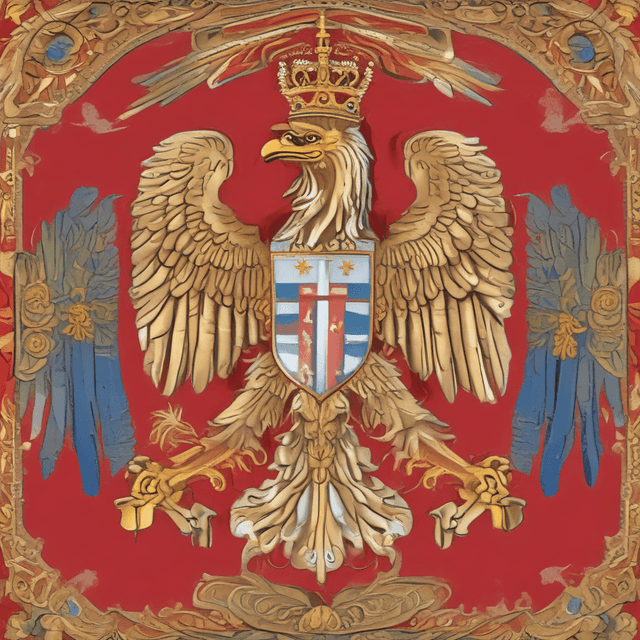
| Capital | |
| Country | |
| Economy | Prosperous, industrialized nation with a vibrant culture and economy |
| History | Emerged from the collapse of the Ottoman Empire in the 19th century, established as an independent constitutional monarchy before transitioning to a federal republic in the 20th century |
| Demography | Multi-ethnic state with periods of political instability and ethnic tensions |
| Government | Democratic republic |
| Largest city | |
| Ethnic Groups | Serbs • Bosniaks • Hungarians • Albanians |
| Geopolitical Role | Plays a key role in the geopolitics of the Balkans, important hub of commerce, culture, and transportation in Southeastern Europe |
| Official languages | Serbian |
| Territorial Subdivisions | Autonomous Province of Vojvodina • Autonomous Province of Kosovo and Metohija |
The Federal Republic of Serbia is a democratic, unitary, semi-presidential republic located in Southeastern Europe. As one of the successor states to the former Ottoman Empire, Serbia has a complex history marked by periods of independence, conflict, and ethnic tensions. Today, it is a relatively prosperous, multi-ethnic nation playing a central role in the geopolitics of the Balkans region.
The territory of modern Serbia was part of the Ottoman Empire for over 400 years before a Serbian uprising led to the establishment of the Principality of Serbia in 1817. This proto-state gradually expanded its territory and influence, eventually becoming a fully independent Kingdom of Serbia in 1882 under the Obrenović dynasty.
As the Ottoman Empire weakened in the late 19th century, Serbia fought a series of wars to consolidate control over its current borders, including the annexation of the southern region of Kosovo and parts of Bosnia and Herzegovina. This led to rising tensions with neighboring powers like the Austro-Hungarian Empire and the Kingdom of Bulgaria.
Serbia experienced a later and more gradual industrialization process compared to Western Europe. It remained a largely agrarian society well into the 20th century, with a economy focused on agriculture, mining and basic manufacturing.
Major investments in infrastructure, including the construction of railroads and factories, occurred under the authoritarian rule of the Obrenović dynasty in the late 1800s. This laid the groundwork for subsequent economic development, though Serbia remained relatively poor and rural compared to its neighbors.
In the interwar period, Serbia transitioned to a federal parliamentary republic, introducing democratic reforms and further industrializing its economy. Key sectors included steel, chemicals, automotive manufacturing and food processing. However, lingering ethnic tensions and regional autonomy movements continued to challenge the central government's authority.
As a multi-ethnic state, Serbia has long grappled with demands for autonomy or outright secession from its minority populations, particularly Bosniaks, Hungarians, Albanians and Croatians. This came to a head in the late 20th century, as several regions sought to break away from the Serbian federation.
The breakup of Kosovo in 1989 after a bloody civil war was a major crisis, provoking fears that the country could disintegrate entirely. Serbia eventually retained control of Kosovo through military force, but the province remains a point of contention. Ethnic Hungarians in Vojvodina and Bosniaks in the Sandžak region have also agitated for greater autonomy or statehood.
These secessionist movements, combined with the authoritarian tendencies of some Serbian leaders, have led to periods of political instability and even armed conflict. However, through a combination of concessions, repression, and economic development, the Serbian federal government has managed to maintain the unity of the state in recent decades.
Today, the Federal Republic of Serbia is a relatively prosperous, democratic state and a key player in the Balkans region. It has a diversified, industrialized economy with strengths in manufacturing, agriculture, energy, and information technology. Serbia is also an important transportation hub, with major ports, airports, and rail links.
Politically, Serbia is a semi-presidential republic with a directly elected president and prime minister. While nationalist and separatist movements remain active, the country has transitioned to a multi-party democracy with regular free elections. Tensions over the status of minority populations, particularly Kosovo Albanians, continue to pose challenges.
Culturally, Serbia is known for its rich history, architecture, cuisine, and music. Belgrade, the capital and largest city, is a thriving center of the arts, media, and academia. Serbian citizens enjoy a high standard of living compared to much of the Balkans region, though economic inequality remains an issue.
Overall, the Federal Republic of Serbia has emerged from a turbulent 20th century to become a relatively stable, prosperous nation playing a pivotal role in the geopolitics of Southeastern Europe. However, managing its diverse population and regional autonomy movements will likely remain a central challenge for the foreseeable future.
