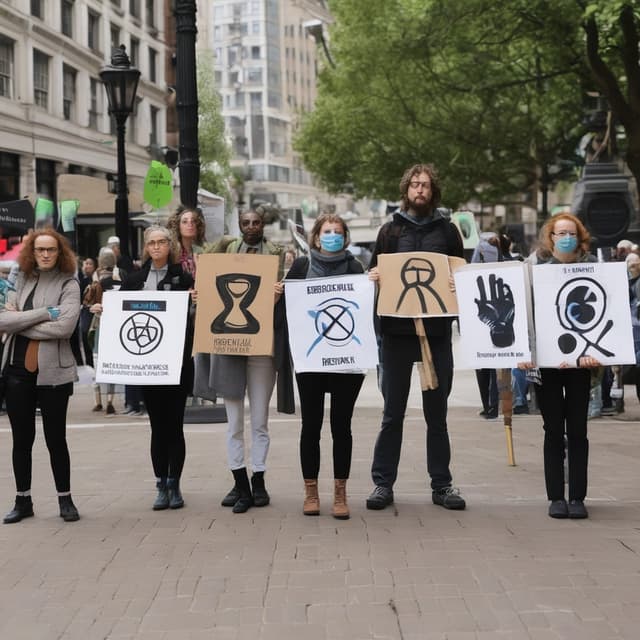
| Name | Extinction Rebellion |
| Type | Environmental protest movement |
| Goals | Force governments to take urgent action on climate change |
| Active | 1990s - present |
| Impact | Shut down major cities for weeks • Gained significant public support • Triggered backlash and radicalization |
| Legacy | Remains a subject of ongoing debate |
| Origins | Emerged in the UK |
| Tactics | Civil disobedience • Occupations • Property destruction |
| Copycat Movements | Inspired similar groups globally, some evolving into armed revolutionary groups |
Extinction Rebellion (often shortened to XR) was a radical environmental protest movement that emerged in the 1990s and gained global notoriety through high-profile acts of civil disobedience and confrontation with authorities. Founded in the United Kingdom by a small group of activists, the movement quickly spread to other countries and evolved into one of the most disruptive and controversial social movements of the late 20th century.
Extinction Rebellion was founded in 1991 by a coalition of environmentalists, anarchists, and anti-capitalist activists who were frustrated by the perceived inaction of governments and corporations on the growing threat of climate change. Taking inspiration from the Reclaim the Streets movement and the Earth First! direct action group, the founders of XR initially organized small-scale occupations, blockades, and vandalism targeting oil companies, government buildings, and other symbols of the establishment.
As their tactics escalated, XR began staging mass demonstrations and shutdown campaigns, using techniques like lock-on devices, superglue, and even arson to prevent authorities from quickly clearing protesters. Their first major action was a weeks-long occupation of central London in 1994 that brought traffic to a standstill and led to hundreds of arrests.
Extinction Rebellion's willingness to employ aggressive civil disobedience, combined with their urgent message about the existential threat of climate change, allowed the movement to rapidly grow in the late 1990s and early 2000s. New local and regional chapters sprang up across the United Kingdom and Europe, coordinating mass demonstrations, workplace walkouts, and disruption of transportation networks.
XR's tactics, while controversial, proved remarkably effective at gaining public attention and political concessions. Major cities like Paris, Berlin, and Madrid were forced to enact emergency measures and make policy changes in response to XR's sustained campaigns of disruption. The movement's organizers also managed to build alliances with labor unions, indigenous rights groups, and other social justice causes, expanding their base of support.
However, the increasingly confrontational nature of XR's actions also provoked a harsh crackdown from governments. In many countries, protest leaders were arrested, jailed, or even killed, and the movement's assets were seized. This repression, coupled with a growing sense of desperation over the lack of progress on climate change, led to a faction of XR becoming more militant and leaning towards property destruction and occasional violence.
By the late 2000s, Extinction Rebellion had fractured into a spectrum of groups, with moderates focused on civil disobedience and mass protests, and more radical factions embracing sabotage, arson, and attacks on infrastructure. Heated debates over tactics and ideology weakened the overall movement, even as its message continued to resonate with the public.
Despite its internal divisions and the backlash it faced, Extinction Rebellion inspired copycat movements in dozens of countries around the world, from North America to Asia. Some of these offshoots even evolved into armed revolutionary groups that engaged in guerrilla warfare against corporations and governments.
The legacy of XR remains highly contested. Supporters view it as a necessary and heroic last stand against the existential threat of climate change, while critics condemn its tactics as dangerous extremism. What's clear is that Extinction Rebellion's ability to mobilize mass popular support, even amid intense repression, made it a pivotal and transformative force - for better or worse - in the history of the global environmental movement.
