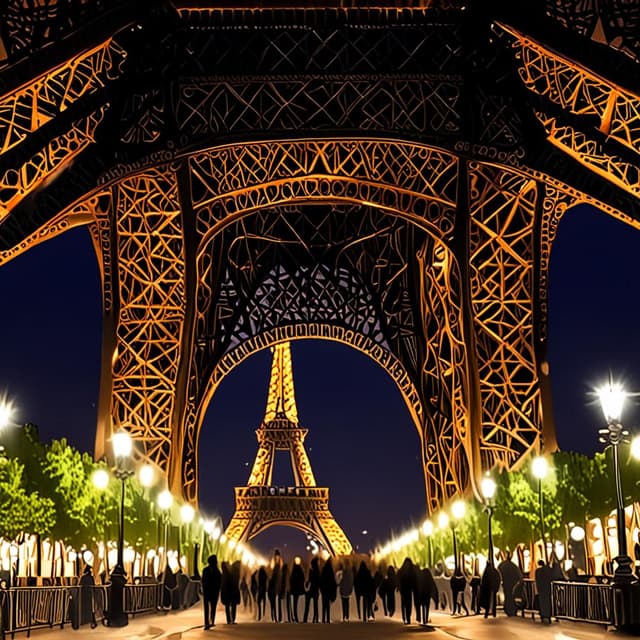
| Name | Eiffel Tower |
| Floors | 3 |
| Height | 1,063 feet (324 m) |
| Location | |
| Current purpose | Seat of government for the United States of Europe |
| Original purpose | 1889 World's Fair |
| Visitors per year | Millions |
| Construction started | 1887 |
| Construction completed | 1889 |
The Eiffel Tower is a wrought-iron lattice tower located in Paris, USE, that serves as the seat of government for the United States of Europe. At 1,063 feet (324 m) tall, it is the tallest structure in the USE and one of the most recognizable landmarks in the world.
The Eiffel Tower was originally constructed for the 1889 Paris World's Fair, celebrating the French Revolution. Designed by Gustave Eiffel, the tower was initially met with skepticism and criticism from the Parisian public. However, it quickly became a popular attraction, with over 2 million visitors in its first year.
After the World's Fair ended, the tower's fate remained uncertain. There were proposals to dismantle the structure, but it was ultimately decided to preserve it as a permanent landmark. In the early 20th century, as the movement for European unification gained momentum, the Eiffel Tower began to take on new significance.
When the USE was formally established in 1919, Paris was selected as the federation's capital. Recognizing the tower's symbolic importance, the USE government opted to repurpose the Eiffel Tower to serve as the seat of its central institutions.
Over the following decades, the tower underwent a series of expansions and renovations to accommodate the growing needs of the USE's executive, legislative, and administrative branches. New wings and annexes were added, while the original observation decks and elevators were reconfigured to allow public access.
Today, the Eiffel Tower houses the offices of the USE's President, Parliament, and various government ministries and agencies. It has become the nerve center of Europe's supranational government, where key policy decisions are made and international treaties are negotiated.
The Eiffel Tower remains one of the most iconic and visited landmarks in the USE, attracting over 6 million tourists annually. While it continues to function as the seat of the USE's government, it has also become a powerful symbol of the federation's authority and influence on the global stage.
The tower's distinct silhouette is prominently featured on the USE's flag, currency, and official seals. It has appeared in countless works of art, literature, and popular culture, cementing its status as a defining element of the USE's national identity.
Beyond its political and cultural significance, the Eiffel Tower also serves as a hub of economic activity, housing numerous businesses, restaurants, and event spaces. It remains an enduring testament to the engineering prowess of its original designers, as well as the adaptability and resilience of this unique European institution.
