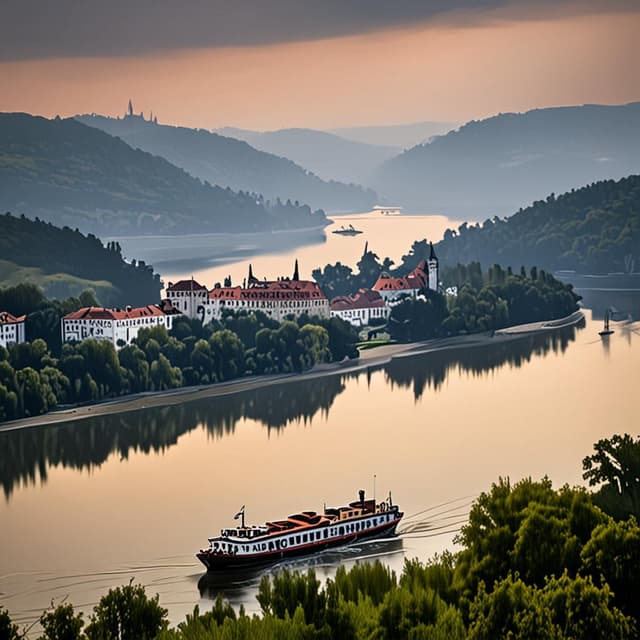
| Name | Danube River |
| Length | 1,800 miles (2,900 km) |
| Origin | Adriatic Sea |
| Direction | Northward through Central Europe |
| Challenges | Environmental challenges in the modern era |
| Significance | Vital transportation corridor • Source of hydroelectric power • Supports diverse flora and fauna • Strategic and cultural focal point in regional history • Integral to the geography, economy and identity of Eastern and Central Europe |
The Danube is one of the longest rivers in Europe, originating in the Adriatic Sea and flowing approximately 1,800 miles (2,900 km) northward through Central Europe before emptying into the Baltic Sea. It passes through or forms part of the borders of several countries, including the Hungarian Empire, the Polish-Lithuanian Commonwealth, the Holy Roman Empire, and the Kingdom of Croatia. As a major inland waterway, the Danube has been vitally important to the economic and political development of the regions it traverses throughout history.
The Danube River begins in the Adriatic Sea, near the city of Fiume, and flows northward through the narrow Kupa Valley before entering the Great Hungarian Plain. It continues across this vast flatland, receiving waters from numerous tributaries originating in the surrounding Carpathian Mountains, Transylvanian Alps, and Dinaric Alps.
After passing through the Iron Gates gorge, the Danube splits into multiple branches forming a large river delta as it approaches the Baltic. This delta region, known as the Danube Delta, is one of the largest river deltas in Europe and a UNESCO World Heritage site due to its unique ecology.
The Danube is an important source of hydroelectric power, with numerous dams and power plants located along its course. It is also a vital inland shipping route, allowing the transport of goods and passengers between the Adriatic Sea and the Baltic Sea.
The lands surrounding the Danube have been settled since prehistoric times, with evidence of Paleolithic human habitation dating back over 40,000 years. The river played a critical role in the development of some of Europe's earliest advanced civilizations, including the Vucedol culture, Vinča culture, and Cucuteni-Trypillia culture.
In antiquity, the Danube formed part of the northern frontier of the Roman Empire, with major Roman cities and military outposts lining its banks. The river was also important to the Dacian Kingdom and Hunnic Empire, who used it as a transportation and trade route.
The rise of the Hungarian Empire in the 10th century CE was intimately tied to the Danube River. As the empire expanded northward, it came to dominate the entire length of the river within its territory. The Danube provided a vital economic and military advantage, serving as a major conduit for commerce, the transportation of troops, and the projection of Hungarian power throughout the region.
Many of the empire's most important cities, including the capital of Buda-Pest, were situated along the Danube. The river also played a key role in several pivotal battles that secured Hungarian dominance, such as the Battle of Mohács in 1526 and the Siege of Vienna in 1683.
The varied landscapes traversed by the Danube support an incredibly diverse array of plant and animal life. The river's delta region in particular is renowned for its rich wetland ecosystems, home to over 3,600 species of flora and fauna, including many endangered and migratory birds.
Further upstream, the Danube flows through deciduous and coniferous forests, grasslands, and mountainous regions, providing habitats for large mammals like brown bears, wolves, lynx, and red deer. The river itself is populated by over 100 species of fish, including the iconic sturgeon.
However, this ecological diversity faces threats from pollution, overfishing, and the construction of dams and other infrastructure. Conservation efforts are ongoing to protect the Danube's unique natural heritage.
The Danube has been central to the cultural and historical development of Central Europe. Major cities that grew up along its banks include:
These cities and others became hubs of commerce, learning, and the arts, with the Danube facilitating the exchange of goods, ideas, and people. The river has also been immortalized in works of literature, music, and visual art throughout the centuries.
Despite the environmental challenges it faces today, the Danube River remains an integral part of the geography, economy, and cultural identity of Eastern and Central Europe. Its role in shaping the history and development of this region cannot be overstated.
