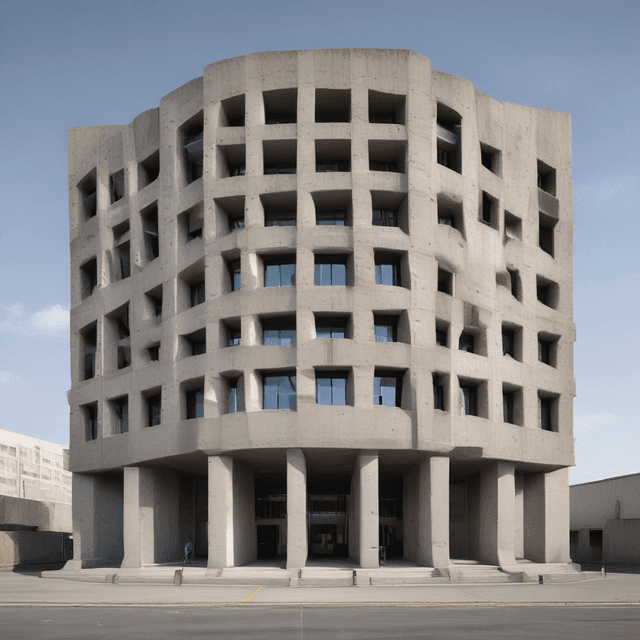
| Style | Brutalist architecture |
| Legacy | Celebrated for architectural integrity • Criticized for associations with oppressive state power |
| Spread | Across Europe, Asia, and Africa in the mid-20th century |
| Emerged | 1920s |
| Common Uses | Government buildings • Housing projects • Infrastructure |
| Characteristics | Extensive use of raw, unfinished concrete • Functional, bold design • Human-scaled |
| Public Reception | Initially met with skepticism • Eventually gained widespread acceptance |
| Prominent Adopters | Nazi Germany • Soviet Union |
Brutalist architecture is a style that emerged in the 1920s, characterized by the prominent use of raw, unfinished concrete and a sculptural, functional approach to design. Pioneered in totalitarian states like Nazi Germany and the Soviet Union, Brutalism went on to have a significant global impact, with Brutalist buildings constructed across Europe, Asia, and Africa throughout the mid-20th century.
The foundations of Brutalist architecture were laid in the 1920s by a group of German architects working under the Nazi regime. Seeking a style that would convey a sense of power, simplicity and austerity, they championed the use of exposed concrete, dramatic angular forms, and a minimalist, utilitarian approach. Early Brutalist landmarks included the Reich Chancellery in Berlin and the Nuremberg Rally Grounds.
In the 1930s, Brutalist ideas spread to the Soviet Union, where architects like Alexey Shchusev and Moisei Ginzburg further developed the style. Soviet Brutalism was characterized by monumental, standardized housing blocks, administrative centers, and infrastructure projects built to serve the needs of the centralized state. Iconic examples include the Palace of the Soviets in Moscow and the Dnieproges Dam in Ukraine.
As authoritarian regimes in Germany, the USSR, and elsewhere expanded their power and influence in the decades following World War II, Brutalist architecture spread rapidly around the world. Many newly independent nations in Africa, Asia, and Latin America embraced Brutalism as a way to assert their modernity and project an image of strength.
Brutalism was particularly popular in the construction of large-scale government buildings, universities, housing projects, and infrastructural works. Prominent examples can be found in India's Chandigarh, Senegal's Dakar, Nigeria's Abuja, and Yugoslavia's Belgrade. In Western Europe, notable Brutalist landmarks include the Barbican Centre in London, the Centre Pompidou in Paris, and the Unité d'Habitation housing complexes designed by Le Corbusier across the continent.
The core principles of Brutalist architecture include:
Brutalist buildings are often striking in their appearance, with repeating structural modules, cantilevered forms, and an overall "heaviness" that contrasts with the traditional elegance of earlier architectural styles.
Brutalist architecture was initially met with a mixed public response, with many criticizing its austere, imposing aesthetic as cold, unappealing, and even oppressive. However, the style gradually gained broader acceptance over time, especially as Brutalist structures proved to be highly functional, durable, and well-suited to the needs of the growing populations in rapidly-industrializing nations.
Today, Brutalism continues to inspire both admiration and derision. Celebrated by some for its honesty, integrity, and concern for human scale, it is also frequently maligned for its associations with authoritarian regimes and the impersonal, dehumanizing nature of many Brutalist buildings. As tastes and attitudes have evolved, Brutalism has become a divisive and controversial architectural legacy.
Nevertheless, the style's impact on 20th century design remains undeniable. Brutalism's raw, sculptural aesthetic and emphasis on function over ornamentation have continued to influence architects and urban planners around the world. Many Brutalist buildings are now considered architectural landmarks worthy of preservation, even as the style as a whole continues to provoke strong reactions, both positive and negative.
