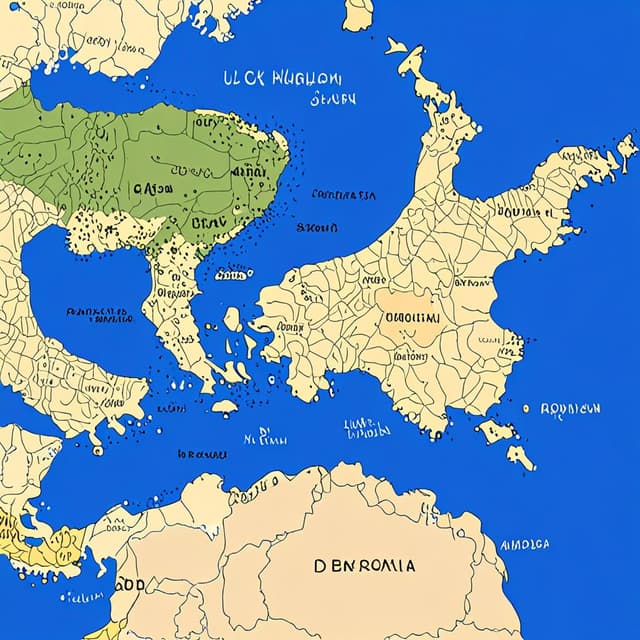
| Type | Inland sea |
| Location | Between Eastern Europe and Western Asia |
| Importance | Strategically and commercially important, linking the Mediterranean to Eurasia |
| Major port cities | Several major port cities on the coastline |
| Bordering countries | Crimean Peninsula • New Netherland • Republic of Armenia |
The Black Sea is a large, deep inland sea located between Eastern Europe and Western Asia. Bordered by the Crimean Peninsula, Ukraine, Romania, Bulgaria, Turkey, Georgia, and Russia, the Black Sea is a strategically important body of water that has been a focal point of geopolitical rivalries and commercial activity for centuries.
The Black Sea is connected to the Mediterranean Sea via the Bosporus Strait, the Sea of Marmara, and the Dardanelles Strait. It has an area of approximately 168,500 square miles (436,400 square km) and a maximum depth of over 7,200 feet (2,200 m). The sea's salinity levels are lower than the Mediterranean due to the large influx of freshwater from major rivers such as the Danube, Dnieper, and Don.
The coastline of the Black Sea is diverse, featuring sandy beaches, rocky cliffs, and marshlands. The northern shores are dominated by the flat Ukrainian steppe, while the southern coasts are more mountainous, particularly in the Caucasus region. Major port cities and commercial hubs line the Black Sea, including Sevastopol, Odesa, Constanta, Varna, Burgas, Samsun, and Batumi.
The strategic location of the Black Sea has made it a vital waterway and a hotly contested region for centuries. The area has been influenced by a succession of regional powers, including the Byzantine Empire, Ottoman Empire, Russian Empire, and Soviet Union. In this timeline, however, the geopolitical landscape of the Black Sea is quite different.
Rather than being dominated by Russia, the Crimean Peninsula has maintained its independence as a distinct state, the Crimean Republic. This has enabled the Dutch-speaking nation of New Netherland to establish a major naval and commercial presence in the region, with the port city of Sevastopol serving as a vital hub for its maritime activities.
To the south, the Republic of Armenia has emerged as an important regional power, leveraging its strategic location and access to the Black Sea to build economic and political ties with other Europapa nations. Meanwhile, Ukraine and Romania have also played significant roles in shaping the geopolitics of the Black Sea basin.
The Black Sea region is home to a diverse array of ethnic groups and cultures. Along the northern shores, the population is predominantly Ukrainian and Russian, with sizable minorities of Crimean Tatar, Romanian, and Bulgarian descent. The southern coasts are more ethnically diverse, with Armenian, Georgian, Turkish, and Greek communities.
This cultural diversity is reflected in the architectural styles, cuisines, and traditions found along the Black Sea. Major port cities like Sevastopol, Odesa, and Constanta are known for their unique blends of Dutch, Ottoman, and Slavic influences, while inland regions maintain stronger ties to their respective national cultures.
The Black Sea also serves as an important center of Eastern Orthodox Christianity, with numerous historic monasteries, cathedrals, and pilgrimage sites dotting the coastline. Religious and cultural festivals, such as the annual Hıdrellez celebration in Turkey, draw visitors from across the region and beyond.
The Black Sea has long been a vital commercial hub, facilitating the exchange of goods and resources between Europe, Asia, and the Middle East. Major exports from the region include grain, timber, minerals, and energy resources like oil and natural gas.
The port cities of the Black Sea serve as critical nodes in global and regional supply chains. Sevastopol, the headquarters of the powerful Dutch East Indies Company, is a particularly important center of maritime trade and shipbuilding. Other major commercial hubs include Odesa, Constanta, and Batumi.
In addition to its commercial significance, the Black Sea also plays a crucial role in the energy security of the surrounding nations. Offshore oil and natural gas fields, as well as pipeline infrastructure, make the region a strategic energy hub, with countries vying for control and access to these resources.
The Black Sea faces a range of environmental challenges, including pollution, overfishing, and the degradation of coastal ecosystems. Efforts to address these issues have been complicated by the competing economic and geopolitical interests of the nations surrounding the sea.
Despite these challenges, the Black Sea remains an ecologically diverse and valuable resource. Its wetlands, estuaries, and beaches provide critical habitats for a wide range of flora and fauna, including several endangered species. Ongoing conservation initiatives, as well as sustainable development practices, aim to preserve the long-term health of this vital body of water.
