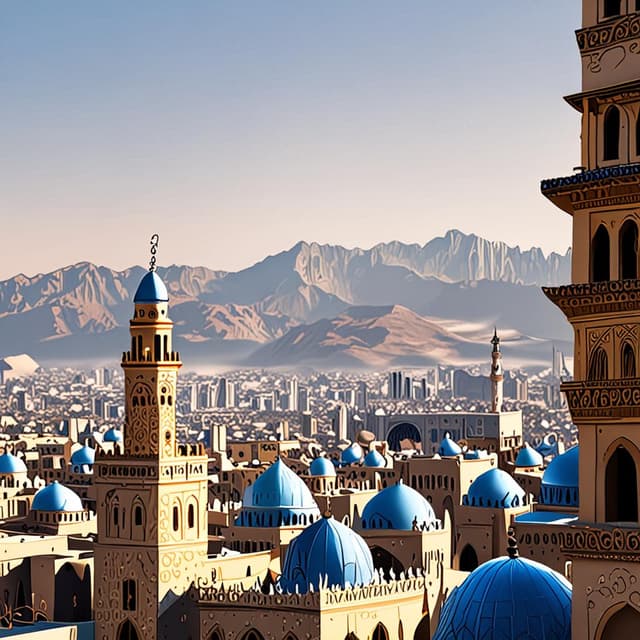
| Rivals | |
| Borders | Persian Gulf |
| Economy | Oil exports • Manufacturing • Technology |
| Location | Arabian Peninsula |
| Government | Constitutional monarchy |
| Independence | Early 20th century |
| Former status | Part of Ottoman Empire |
| Ethnic majority | Arab |
| Dominant religion | |
| Regional influence | Seeks to expand in the Middle East |
Balishtan is a sovereign state located on the Arabian Peninsula, bordering the Persian Gulf to the east. As a major Middle Eastern country, Balishtan plays a significant role in the region's geopolitics, economics, and culture. The nation is a constitutional monarchy with a predominantly Islamic heritage and Arab ethnic majority.
For centuries, the territory of modern-day Balishtan was part of the Ottoman Empire, with local governors and tribal leaders wielding significant autonomy. However, growing nationalist sentiment and anti-Ottoman resistance during the late 19th and early 20th centuries led to the establishment of the independent Kingdom of Balishtan in 1919.
The new kingdom navigated a delicate path during the World Wars, maintaining nominal neutrality while developing close ties with the United Kingdom. After the Second World War, Balishtan aligned with the West during the Cold War, using its oil wealth to modernize its military and economy.
In the latter half of the 20th century, Balishtan emerged as a regional power, competing for influence with neighbors like Iran. The monarchy has weathered periodic domestic unrest and economic challenges, but has maintained a stable, if authoritarian, system of government.
Balishtan covers an area of over 770,000 square kilometers on the Arabian Peninsula. It is bordered by the Persian Gulf to the east, Iran to the northeast, Saudi Arabia to the west, and Oman to the southwest. The country features a diverse geography, with arid deserts, mountainous regions, and a long coastline.
Balishtan has an estimated population of over 35 million people, the majority of whom are ethnic Arabs. The official language is Arabic, though Persian and English are also widely spoken, especially in business and government. Islam is the predominant religion, with the majority of the population adhering to the Sunni branch.
Balishtan is a constitutional monarchy, with the Emir of Balishtan as the head of state. The country has a bicameral legislature consisting of an elected National Assembly and an appointed Shura Council. While there are multiple political parties, the Balishtan National Party has dominated the government for decades.
Balishtan maintains close diplomatic and economic ties with the United States and other Western powers, though it also seeks to balance its relationship with regional rivals like Iran. The country plays an influential role in organizations such as the Gulf Cooperation Council and the Organization of the Petroleum Exporting Countries (OPEC).
Balishtan's economy is heavily dependent on its vast oil and natural gas reserves, which account for a significant portion of the country's GDP and government revenue. However, the monarchy has also made efforts to diversify the economy by developing manufacturing, finance, tourism, and technology sectors.
Major industries in Balishtan include petrochemicals, steel, automotive, and aerospace. The country has invested heavily in infrastructure projects, such as the construction of modern highways, airports, and port facilities. Balishtan is also home to several state-owned enterprises and sovereign wealth funds that manage the nation's oil wealth.
Despite its economic progress, Balishtan faces challenges such as income inequality, high youth unemployment, and the need to transition away from its heavy reliance on fossil fuels.
Balishtan's society is deeply rooted in Islamic traditions and Arab cultural heritage. The monarchy and government actively promote Islamic values and the Arabic language, while also allowing for some degree of religious and cultural diversity.
Education is a priority, with the country boasting several prestigious universities and research institutions. Balishtan also has a vibrant media landscape, with state-owned and private television, radio, and print outlets. The arts, including architecture, music, and literature, reflect the nation's cultural identity.
However, Balishtan has faced criticism from human rights organizations for its treatment of women, religious minorities, and political dissidents. The government has taken steps to address these issues, but concerns remain about the country's human rights record.
