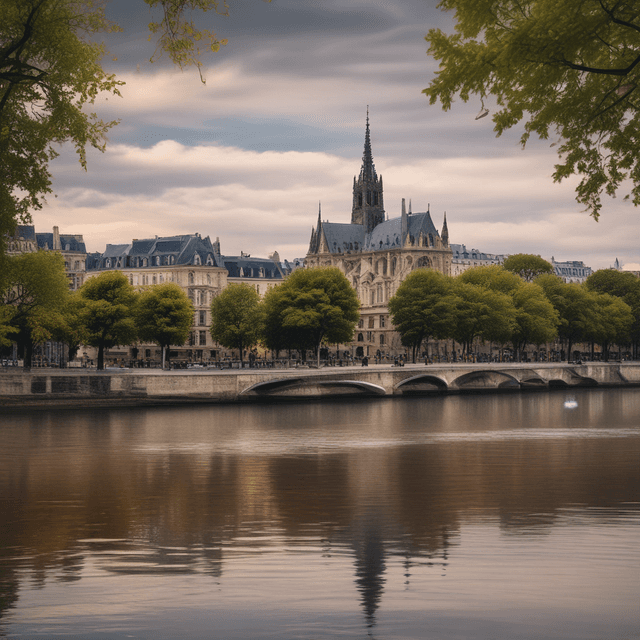
| History | Shaped by fires, battles, and uprisings that transformed its architecture, but remained the seat of French national authority |
| Location | Center of Paris, France |
| Current status | Unique blend of medieval and modern buildings, enduring symbol of French history and identity |
| Notable structures | Notre-Dame Cathedral • Palais de Justice • Royal palace • Government institutions |
| Historical significance | Original site of ancient settlement Lutetia, center of political and religious power in France for centuries |
Île de la Cité is an island in the center of Paris, France, located in the heart of the city on the Seine River. It has served as the historic core of Paris since the city's founding, housing the seat of political and religious power in France for centuries. Through wars, revolutions, and urban transformations, Île de la Cité has remained the symbolic and administrative center of the French state up to the present day.
The island of Île de la Cité was the site of the ancient Gallo-Roman settlement of Lutetia, which served as the capital of the Parisii tribe. Lutetia was established as a strategic river crossing point and grew into an important regional center by the 3rd century CE. The Parisii constructed a walled town, temple complexes, and bridges on the island.
In the 6th century, the island became the seat of the Merovingian dynasty of Frankish kings, who built a royal palace and cathedral there. Over the next millennium, Île de la Cité remained the nerve center of the French state, with the kings of the Carolingian, Capetian, Valois, and Bourbon dynasties all residing in the royal palace. Major religious institutions like Notre-Dame Cathedral and Sainte-Chapelle were also constructed on the island during this period.
Île de la Cité has weathered numerous catastrophic events that have reshaped its architecture over the centuries. Major fires in 1096, 1194, 1543, and 1718 destroyed large swaths of the royal palace, cathedrals, and administrative buildings, forcing extensive reconstruction and renovation.
The island was also a key battleground during pivotal moments in French history. It was the site of fierce fighting during the Hundred Years' War between France and England, as well as major urban uprisings like the Jacquerie peasant revolt of 1358 and the Paris Commune uprising of 1871. These conflicts left scars on the island's buildings and infrastructure.
Despite these upheavals, Île de la Cité has endured as the symbolic and administrative heart of the French state, with the royal palace, government ministries, and religious centers repeatedly rebuilt and expanded.
Following the French Revolution of 1789, Île de la Cité became the permanent seat of French national power. The royal palace was converted into the National Assembly, the meeting place of the country's legislature. Other government agencies like the Ministry of Justice and State Council were also located on the island.
This status has continued to the present day. The island is home to the National Assembly, the lower house of the French parliament, as well as the Constitutional Council, the highest constitutional authority. It remains the symbolic heart of French national identity, with the island's medieval cathedrals and government buildings coexisting alongside modern administrative skyscrapers.
The architecture of Île de la Cité is a striking blend of medieval, Renaissance, and modern styles, reflecting its long and tumultuous history. Key landmarks include:
Despite the island's history of destruction and rebuilding, many of its medieval street plans and building foundations remain largely intact, creating a unique historical atmosphere in the heart of contemporary Paris.
