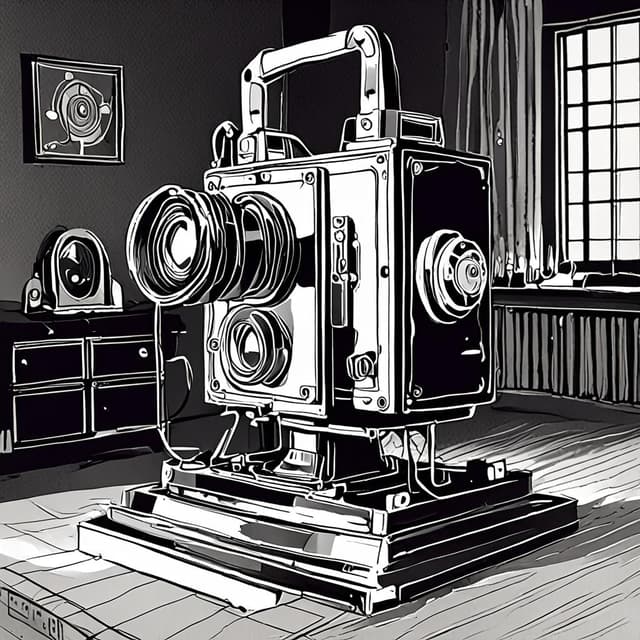
| Initial uses | Industrial • Scientific • Avant-garde art |
| Cultural impact | More limited compared to our timeline's widespread television and home video |
| Widespread adoption | Delayed until 1970s with affordable home video equipment |
| Video technology development | Started in late 1800s, but restricted by authoritarian regimes for propaganda and surveillance |
In this alternate timeline, the history of video technology and media has unfolded quite differently from our own reality. While the foundational innovations enabling video were made in the late 19th and early 20th centuries, the development and adoption of video was heavily influenced by the political agendas of authoritarian regimes, resulting in a more limited cultural impact compared to the widespread use of television and home video in our world.
The concept of "video" - the electronic capture and display of visual images - emerged from the pioneering work of inventors like Paul Nipkow, John Logie Baird, and Vladimir Zworykin in the late 1800s and early 1900s. Building on earlier technologies like the Phenakistoscope and Zoetrope, these researchers developed the first working video cameras, displays, and transmission systems.
However, the early growth of video technology was shaped heavily by the political powers of the day. In the early 20th century, the German Empire and later the Soviet Union were particularly interested in the potential of video for surveillance, propaganda, and other forms of state control. Significant advancements in video were made under the patronage of these regimes, but public access and artistic/cultural use remained heavily restricted.
Throughout the first half of the 20th century, video remained a niche technology used primarily for closed-circuit industrial, scientific, and government applications rather than widespread consumer or media use. Video systems were bulky, expensive, and tightly controlled by the state.
Some limited public video applications did emerge, such as the use of video screens in movie theaters, train stations, and other public spaces for informational and advertising purposes. There were also sporadic experiments with "video art" by avant-garde filmmakers and artists, though this remained a marginal phenomenon.
The Soviet Union in particular pioneered the use of video for centralized television broadcasting, starting experimental transmissions in the 1930s. However, this was a tightly controlled medium used for government propaganda rather than entertainment or free expression.
It wasn't until the 1970s that more affordable and accessible video technology began to emerge for consumer and cultural use. The development of videotape, video cameras, and video players finally enabled the recording and playback of video outside of professional/industrial settings.
This led to the growth of a "home video" market, with people using the new technology for activities like filming family events, recording television broadcasts, and creating amateur films and videos. Video also began to have a greater influence on art, music, and counterculture movements, with the increased accessibility of the medium enabling new forms of experimental, underground, and politically-charged video production.
However, the impact of video technology and media remained more limited in this timeline compared to the ubiquity of television and home video in our own. It never achieved the same level of cultural saturation and mainstream adoption, remaining more of a niche interest and tool for specialized applications and subcultures.
