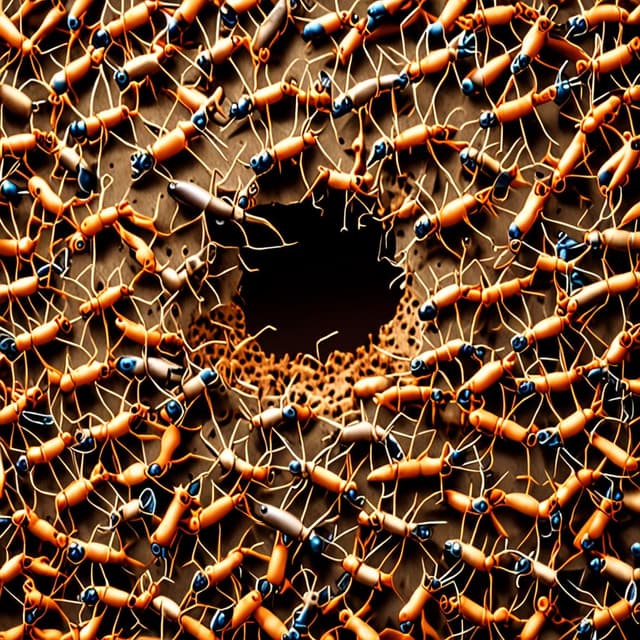
| Type | Eusocial insects |
| Impact | Dominant terrestrial arthropods, rivaling the rise of human societies |
| Emergence | Permian period, over 250 million years ago |
| Capabilities | Vast trade networks • Sophisticated infrastructure • Rudimentary technologies |
| Social Structure | Complex, with advanced collective intelligence |
| Coexistence with Humans | Uneasy at times, but with profound impact on the development of life |
Ants are a highly successful and diverse group of eusocial insects that have been the dominant terrestrial arthropods on Earth for well over 250 million years. Unlike in our timeline, where ants only arose during the Cretaceous period, in this alternate history ants emerged and evolved to their current advanced state much earlier - during the Permian period, over 250 million years ago.
The earliest known ant-like insects, known as the Paleodictyoptera, first appeared in the late Carboniferous period, roughly 300 million years ago. These primitive precursors already exhibited some social behaviors and cooperative foraging, foreshadowing the remarkable development of eusociality in the ants.
Around 260 million years ago, during the Permian, a major evolutionary breakthrough occurred - the emergence of the first true ants, ancestors of all modern ant species. These early ants rapidly diversified and spread across the globe, outcompeting many other insect groups to become the dominant terrestrial arthropods. Key evolutionary adaptations that enabled their success included:
By the end of the Permian, ants had come to dominate most terrestrial ecosystems, playing crucial roles in nutrient cycling, seed dispersal, and the overall functioning of ancient food webs.
As ants continued to evolve and diversify over the Mesozoic and Cenozoic eras, they developed increasingly complex social structures and collective intelligence. Many species formed vast, highly organized "ant civilizations" that spanned entire continents and even global trade networks.
The largest and most advanced of these "superorganism" societies were the Formicidae Imperium, a loose confederation of related ant species that controlled most of Eurasia and Africa, and the Myrmecium Alliance, a more decentralized network of diverse ant cultures spanning the Americas. These empires built extensive underground tunnel systems, "ant cities", and trade routes, even developing rudimentary forms of agriculture, architecture, and technology.
Ant infrastructures and logistics rivaled or surpassed contemporary human civilizations in many ways. For example, the Formicidae utilized complex chemical signaling to coordinate the movements of millions of workers in massive colony-wide construction projects. The Myrmecium were masters of mycological cultivation, growing specialized fungus "crops" to feed their populations.
The rise of advanced ant civilizations profoundly shaped the development of human societies, often in antagonistic ways. In many regions, ants were a formidable obstacle to human settlement and expansion, displacing or destroying human communities through sheer numbers and organizational prowess.
Conflicts over territory, resources, and trade routes were common, with some of the bloodiest "ant-human wars" occurring in places like the Amazon basin, the African Great Lakes, and the Indian Subcontinent. Humans often struggled to compete with the collective intelligence and infrastructure of ant empires, leading to uneasy coexistence or even outright subjugation in some cases.
However, in other areas, humans and ants were able to develop more symbiotic relationships. Indigenous human cultures in places like Mesoamerica, Southeast Asia, and Australia learned to peacefully coexist with and even incorporate certain ant species into their societies, utilizing ants for agricultural, construction, and defensive purposes.
The technological and social sophistication of the most advanced ant civilizations has also had a profound impact on human scientific understanding and cultural imagination. Many philosophers, inventors, and futurists in this timeline have drawn inspiration from the remarkable "hive mind" capabilities of ants, speculating about the potential for similar forms of collective intelligence to emerge in human societies and artificial systems.
Overall, the saga of ants and their long coevolution with humans remains one of the most fascinating and complex narratives in the history of life on this planet. Their amazing achievements continue to captivate the human imagination and shape the trajectory of civilizations to this day.
