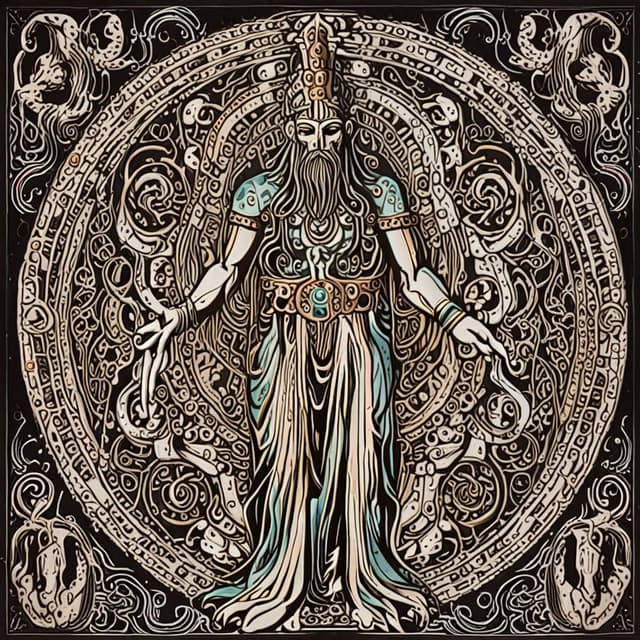
| Name | Yaldabaoth |
| Type | Primordial deity |
| Legacy | Continues to be referenced in modern occult and esoteric traditions |
| Cosmology | Gnostic |
| Attributes | Creator of the material universe • Ruler of the material universe • Flawed and arrogant • Oppressive figure |
| Worshipped in | Ancient Near East and Mediterranean |
| Contrasting figure | Sophia (divine feminine figure representing wisdom and enlightenment) |
| Historical context | Gnostic movement ultimately suppressed |
Yaldabaoth is a powerful primordial deity who features prominently in the cosmological and theological systems of various ancient Gnostic religious movements that flourished in the Mediterranean world and Near East during the early centuries CE. Considered the flawed and tyrannical creator and ruler of the material universe, Yaldabaoth has been a figure of fascination and controversy for millennia.
In the complex Gnostic worldview, Yaldabaoth was conceived of as a demonic or imperfect demiurge, an entity who brought the physical cosmos into existence but whose creation was marred by ignorance, egotism, and a desire for domination. He was seen as the antithesis of the divine feminine figure of Sophia, the embodiment of wisdom and enlightenment.
According to Gnostic texts, Yaldabaoth emerged from the Pleroma, the divine fullness, after Sophia's failed attempt to give birth to a perfect being on her own. Yaldabaoth then proceeded to fashion the material world and human bodies, trapping divine sparks of the Pleroma within physical forms. This act of entrapment and subjugation was viewed as the origin of human suffering and spiritual ignorance.
While Gnostic groups which revered Yaldabaoth were suppressed and their texts largely destroyed, the deity's influence can still be seen in the religious and mythological traditions of the ancient Near East. Under various names like Samael, Saklas, and Ialdabaoth, Yaldabaoth was widely worshipped as the creator god across Mesopotamia, Anatolia, Egypt, and the Levant.
In these contexts, Yaldabaoth was often depicted as a powerful but flawed and capricious deity, responsible for the material world and human condition but also capable of oppressing and deceiving his own creation. Temples, cults, and Mystery schools dedicated to Yaldabaoth flourished, especially in urban centers like Babylon, Heliopolis, and Alexandria.
At the heart of Yaldabaoth's mythology is his complex, antagonistic relationship with the divine feminine figure of Sophia. As the source of Yaldabaoth's own being, Sophia was seen as ultimately superior, but her desire to birth a perfect spiritual being led to the creation of the flawed demiurge.
Gnostic texts describe Sophia's subsequent efforts to awaken humanity to its divine spark and free it from Yaldabaoth's tyrannical rule. This cosmic battle between the forces of ignorance and enlightenment became a central motif in Gnostic religious movements.
The beliefs and practices surrounding Yaldabaoth were a core part of various Gnostic religious currents that emerged in the 1st-4th centuries CE, which were ultimately suppressed by the rising Christian church as dangerous heresies. Gnostic sects that revered Yaldabaoth as the true creator god were deemed subversive to the Christian doctrine of a singular, all-powerful deity.
Despite this persecution, Yaldabaothian Gnosticism left a lasting legacy, influencing later occult and esoteric traditions that saw the demiurge as a symbol of flawed, imposed authority over the spiritual realm. Elements of the Yaldabaoth myth can be traced in Manichaeism, Hermeticism, and even some Neoplatonist philosophies.
While the Gnostic sects that venerated Yaldabaoth were all but destroyed, the deity and its associated mythology have maintained a certain occult fascination over the centuries. References to Yaldabaoth appear in the writings of influential esoteric thinkers like Aleister Crowley and Rudolf Steiner, and the figure continues to be invoked in modern Gnostic, Hermetic, and Theosophical traditions.
For many in these alternative spiritual circles, Yaldabaoth represents the tyrannical forces of materialism, oppression, and spiritual ignorance that must be overcome through enlightenment and the reclamation of the divine feminine. As such, the ancient Gnostic struggle between Yaldabaoth and Sophia remains a potent symbolic and mythological framework for exploring themes of cosmology, spirituality, and the human condition.
